

In the startup world, the core problem has never really been ideas. It has been execution: fragmented tools, inconsistent decision-making, lost context, weak operating discipline, and the familiar gap between early ambition and repeatable commercial progress. Most founders still build companies through a patchwork of documents, advice, spreadsheets, point tools, consultants, and instinct. It is expensive, time-consuming and, above all, chaotic.
LettsGroup VentureFactory 1.0 - available from 2nd April 2026, is a serious attempt to replace that chaos with software. The company has already emerged as a pioneer in venture building as software thanks to its current beta release, with an exciting roster of startup users and partners.
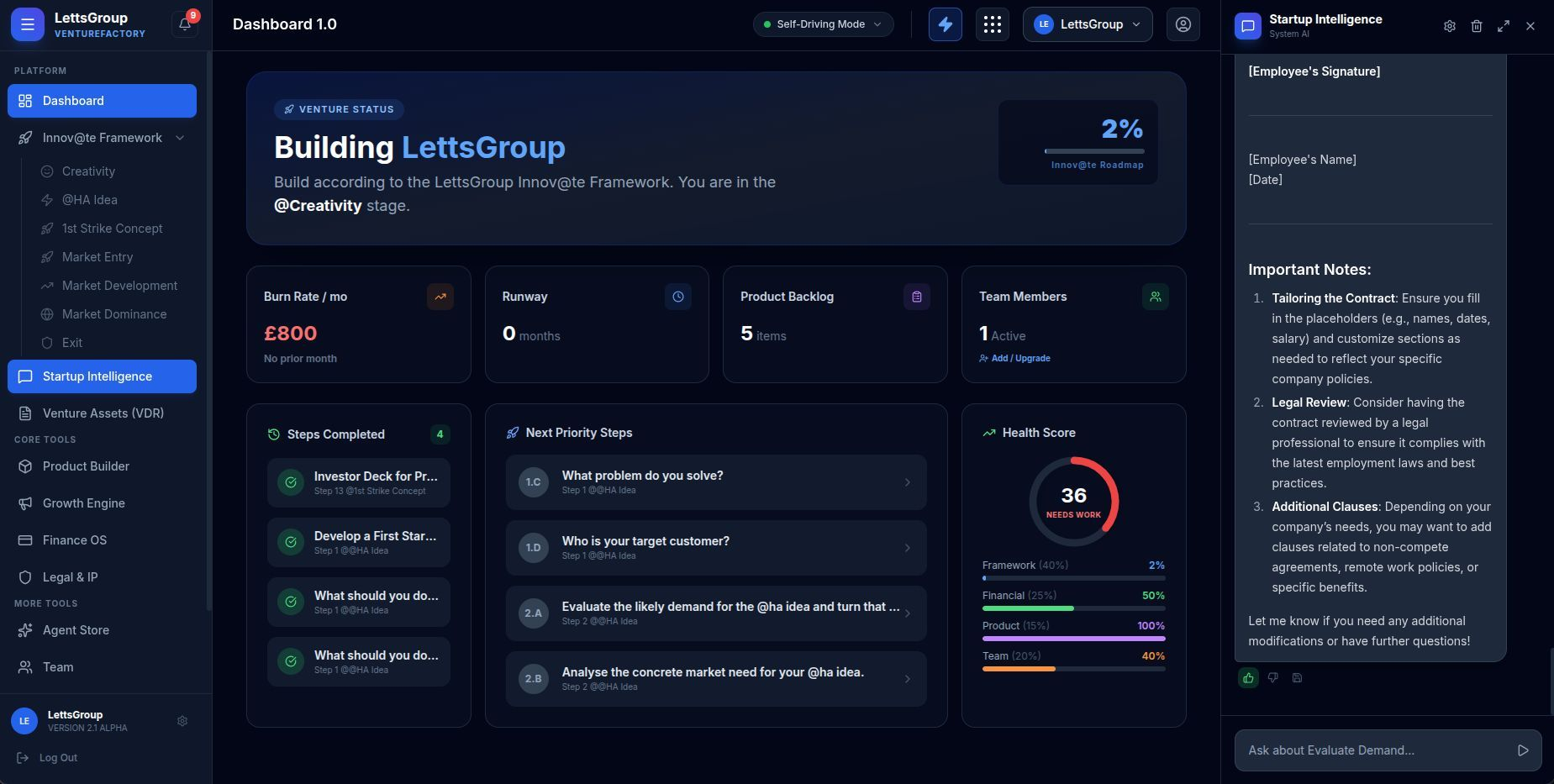
Based on a detailed review of the product specification, VentureFactory 1.0 is best understood not as a single AI assistant, nor as a collection of productivity features, but as a full-stack operating environment for building startups from concept to exit. Its defining move is to turn venture creation into a guided, software-mediated workflow: structured, measurable, collaborative, AI-assisted, and increasingly automatable. That is the breakthrough. It takes what has historically been an artisanal, founder-led process and makes it far more systematised without draining it of strategic flexibility.
At the centre of the platform is the Innov@te 3.0 framework, a seven-stage, 49-step venture-building system that spans idea formation, validation, productisation, market entry, scale-up, market leadership and exit planning. In VentureFactory, this framework is not merely educational content. It is the operating logic of the platform itself. Each stage and step is tied to AI-driven execution, document generation, contextual guidance, collaboration workflows and persistent venture records. That makes VentureFactory materially different from generic AI chat tools or startup template libraries. It is software that aims to move the venture forward, not just talk about it.
VentureFactory 1.0 is a comprehensive AI-powered venture-building platform designed for founders, entrepreneurial teams and innovation-led organisations. It guides users from initial idea generation through company creation, market entry, scaling and exit preparation. The platform combines a structured methodology, a persistent venture-aware AI layer, execution tools, document management, collaboration controls, growth and finance tooling, legal and IP management, and external agent integrations.
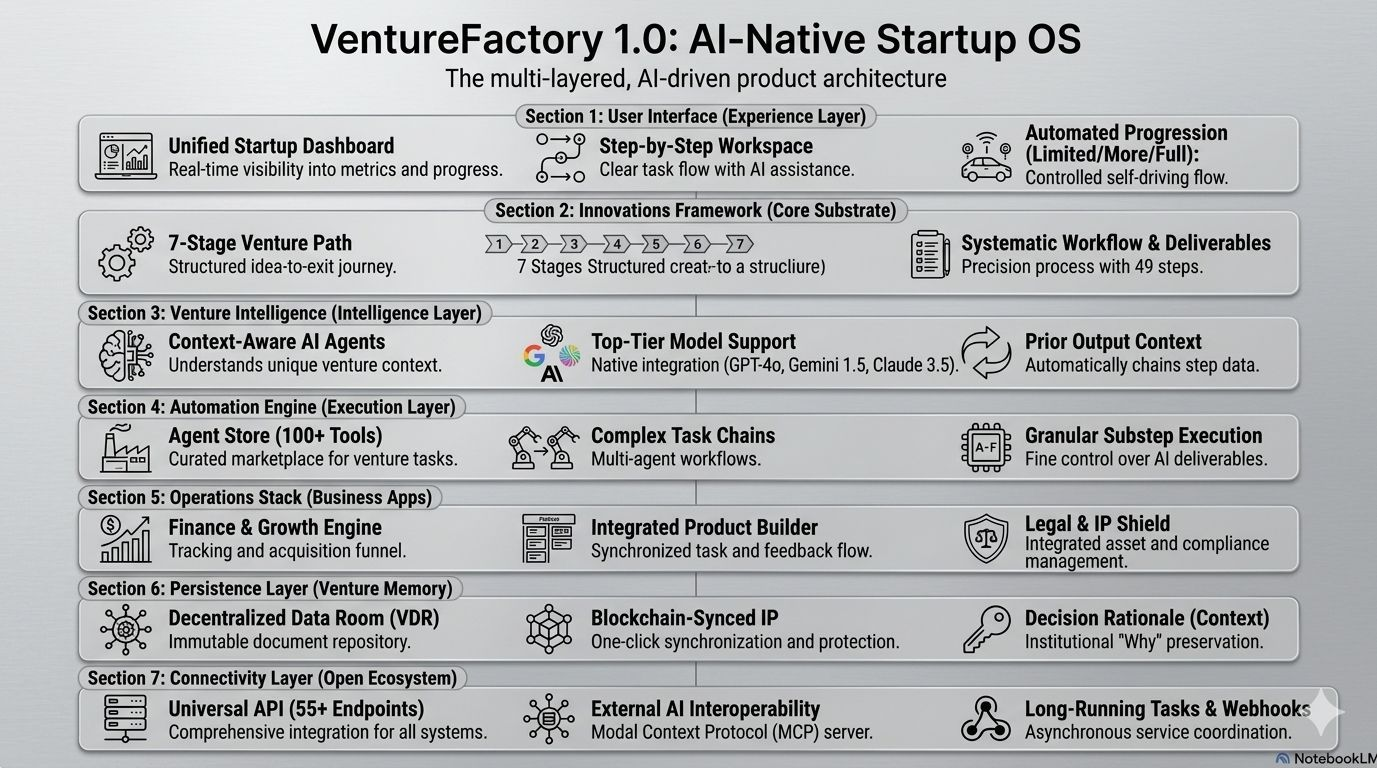
The most important commercial point is this: VentureFactory is not pitching AI as a novelty layer on top of startup work. It is positioning AI as the operating substrate of startup work.
That distinction matters. In most startup environments today, founders still move manually between planning decks, research documents, product backlogs, investor materials, legal files, growth reports and finance trackers. VentureFactory brings these into a single venture context and connects them to an execution system that can generate outputs, preserve them, refine them, and make them available for subsequent steps. The result is a more coherent venture memory and a far more continuous workflow.
The strongest intellectual property in VentureFactory is not any one feature. It is the system design.
The Innov@te framework gives the platform a repeatable logic for venture progression. The framework begins unusually early, with creative formation and founder mindset, then moves into demand validation, market sizing, competition analysis, barriers to entry, financial modelling, exit thinking and founder fit. It then progresses through first-concept creation, Version 1 launch planning, scaling, market development, dominance and exit preparation. This is a more complete view of company creation than most startup platforms attempt. It suggests that LettsGroup is not merely trying to help founders “ship faster”; it is trying to encode a full venture-building doctrine into usable software.
Commercially, that matters because it changes the value proposition. VentureFactory is not just a tool for writing a business plan, generating marketing copy or brainstorming product ideas. It is a software environment for moving from “I have something interesting” to “I have a structured, documented, investable, operational venture.” The specification explicitly frames the value proposition in terms of reducing the time, cost and uncertainty of startup creation, with the ambition of moving founders from idea to investable business in weeks rather than months. That is a very strong market claim, but in product-design terms it is not unreasonable. The platform has been architected to support exactly that outcome.
One of the more compelling parts of VentureFactory 1.0 is its Startup Intelligence Agent. This is described as a persistent AI sidekick available throughout the Innov@te workflow. Crucially, it is contextual: it is aware of the venture’s core information, the current stage and step, and prior outputs generated across the journey. It can also work with multiple model providers and reasoning models, rather than locking the user into a single AI stack.
That matters in practice because founders do not need isolated answers; they need compounding outputs. A venture-building platform becomes powerful when yesterday’s market analysis informs today’s pricing logic, which then informs tomorrow’s fundraising narrative, hiring plan or product roadmap. VentureFactory appears designed for exactly that compounding behaviour. It treats AI outputs as venture assets within a larger system rather than disposable chat responses.
This is one of the clearest markers that VentureFactory belongs in the emerging category of AI-native operating systems, not simply AI-enhanced SaaS.
The platform’s execution engine is another major differentiator. Users can run AI-powered step or substep execution directly within the venture workflow, stream results in real time, and then save outputs into the venture’s data environment. Administrators can tune how execution behaves at a high level, including model selection and contextual inputs, but externally the more important point is what this enables: a founder can move through venture-building work as a sequence of executable tasks rather than disconnected drafting exercises.
In commercial terms, this could materially compress the work involved in early-stage company formation. Market analysis, competitive reviews, financial planning, investor materials, growth planning, product tasks and strategy documents typically consume huge founder time. VentureFactory reorganises those activities into a guided production system. That is how it can credibly argue that startups can be built faster and leaner: not because AI magically removes the need for judgement, but because the platform reduces coordination overhead, document sprawl, repeated setup work and blank-page friction.
The Virtual Data Room is especially significant. All generated documents, uploaded materials and AI outputs can be stored in a single venture repository, with search, filtering, editing, export and creator attribution. Assets can also be synced to LettsCore-backed storage for immutable record-keeping.
For founders, that solves several problems at once.
First, it creates continuity. Key venture materials are less likely to be scattered across laptops, drives, email threads and ad hoc folders.
Second, it improves investability. When the time comes to raise, diligence is easier when market work, product plans, financial thinking, legal records and other core materials already exist inside a coherent system.
Third, it strengthens institutional memory. Early-stage startups often lose strategic context because decisions live in founders’ heads or in transient chats. VentureFactory appears built to preserve that context as structured venture assets.
That may sound mundane beside the AI story, but in practice it is one of the highest-value parts of the release.
VentureFactory 1.0 extends well beyond ideation and planning. The reviewed specification shows native modules for dashboarding, finance, growth, product management, legal and IP administration, team collaboration, notifications and API access. Finance OS covers items such as burn rate and recurring revenue metrics. The Growth Engine tracks funnel performance from impressions through paid users. Product Builder introduces a Kanban-style development workflow. Legal & IP Shield includes cap table management, compliance tracking, IP asset records and contract status management. Team collaboration includes venture roles, invitation workflows and scalable seat management.
Taken together, these components make VentureFactory look less like a planning app and more like a startup operating environment.
That is commercially important because early-stage founders do not buy tools in abstract categories. They buy relief from operational fragmentation. A product that can sit closer to the daily operating centre of the company has more strategic value, more defensibility and a better shot at expansion within the customer account. VentureFactory seems consciously designed around that thesis.
The most forward-looking part of the release is its broader agent architecture. VentureFactory 1.0 includes an Agent Store with more than 100 AI-powered tools, plus a suite of internal core apps, across categories including content, design, finance, fundraising, legal, marketing, software engineering and strategy. It also supports linked agents within the workflow, multi-agent chains and an MCP server that allows external AI clients and agents to interact with venture data in a controlled, bidirectional way.
This is where the platform starts to move beyond conventional SaaS.
In practical terms, this means VentureFactory can become a coordination layer for a wider AI toolchain rather than a closed application. Founders can potentially invoke external specialist tools in context, pass structured prompts, chain outputs together, and maintain venture continuity across those actions. That is a meaningful step toward agentic venture operations.
The significance is hard to overstate. Most startup software still assumes the human user is the only real operator. VentureFactory 1.0 appears designed for a world in which founders, internal teams and external AI agents all participate in venture-building workflows. That is a much more future-facing architecture than typical startup tooling.
For first-time and second-time founders especially, the promise here is powerful.
VentureFactory can help founders work with more structure, make better-informed decisions earlier, produce higher-quality operating materials faster, keep their venture documentation coherent, and reduce dependency on a large external support layer in the earliest stages. The platform can help with market sizing, competitive positioning, financial thinking, roadmap creation, product task management, legal organisation, growth tracking and investor readiness, all inside one venture-aware system.
That does not mean software replaces founder judgement. It means software raises the baseline quality and speed of execution.
The leaner-startup effect is particularly important. Early-stage companies often spend too much too soon on agencies, advisers, disconnected software subscriptions and one-off service providers. A platform like VentureFactory can reduce some of that spend by internalising more of the venture-building workflow into software. When paired with AI, that can let smaller teams operate with more sophistication earlier than would previously have been realistic.
VentureFactory 1.0 Audio Explainer:
VentureFactory 1.0 points toward a broader shift in how startups may be built over the next decade.
For years, software has digitised functions around the startup: CRM, analytics, accounting, design, messaging, project management, fundraising support. VentureFactory takes aim at the startup itself as the object to be systematised. That is a different category ambition. It suggests the rise of “venture building as software” as a serious market segment, particularly as AI makes complex, multi-step knowledge work more executable.
If LettsGroup executes well commercially, VentureFactory could be notable not just as a product launch, but as an early category-shaping release. It is one of the clearer examples of what an AI-native startup operating system might actually look like in production form: methodology-led, execution-centric, document-persistent, collaborative and increasingly agentic.
VentureFactory 1.0 is an ambitious and unusually comprehensive release. It combines a proprietary venture-building framework, contextual multi-model AI, structured execution, document intelligence, collaboration, operational modules, agent integrations and an extensible architecture into a single platform. That alone would make it notable. More importantly, the pieces appear to reinforce one another in a coherent way.
The commercial significance of the release is that it reframes startup creation as a software workflow rather than a loosely managed craft exercise. For founders, that could mean building with greater speed, sharper discipline and lower operating drag. For the broader market, it signals the arrival of a new class of product: AI-native venture building platforms that do not just support founders, but actively help run the startup formation process itself.
In that sense, VentureFactory 1.0 is more than a product update. It is a credible statement that startup building is entering its next software era.
LettsGroup AI VentureFactory 1.0 will be available from April 2nd 2026. Sign-up at Letts.Group.
