

For most of the last twenty years, startup creation followed a relatively predictable formula.
A founder has an idea. They build a prototype. They spend months trying to find customers. They pitch investors. If they're lucky, they get into an accelerator. If they're very lucky, they raise capital. If they're exceptionally lucky, they build a company. The model produced some of the most successful technology businesses in history. It also left most founders behind. Accelerators were designed for a world where expertise, networks, capital, and execution support were scarce resources. A small number of founders were selected. Everyone else was left to figure it out alone. The problem is that the economics of startup creation have changed dramatically.
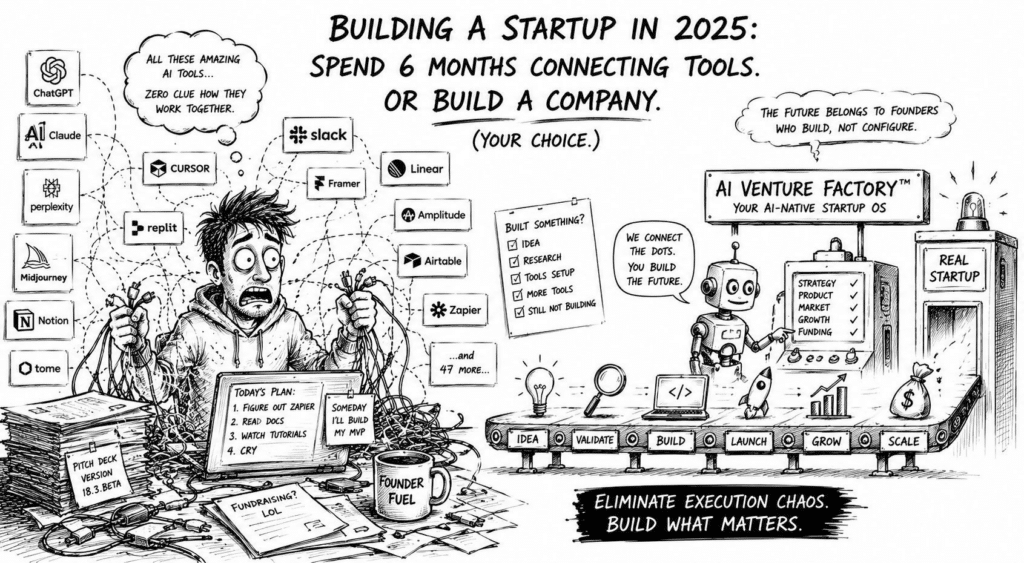
Today, a founder can build software with AI. They can generate marketing campaigns with AI. They can create pitch decks with AI. They can research markets, analyse competitors, write sales copy, produce content, generate customer insights, automate operations, and even create investor outreach campaigns using AI. The barriers to creation have collapsed. The barriers to execution have not. This is the paradox of the AI era. Building has become easier than ever. Building a company remains as difficult as ever. That distinction matters.
The startup ecosystem is currently obsessed with AI coding tools, AI design tools, AI marketing tools, AI sales tools, and AI agents. Every week another product appears promising to make founders more productive. Most of them do. Yet startup failure rates remain remarkably consistent. The reason is simple. Startups do not fail because founders cannot create things. They fail because founders struggle to coordinate hundreds of interconnected decisions. The challenge has shifted from creation to orchestration. A modern founder might use Claude to write product specifications, Cursor to build software, Midjourney to create brand assets, Gamma to generate pitch decks, Perplexity to conduct market research, Clay for outbound sales, Framer for websites, and ChatGPT for content creation. Each tool is powerful. Together they often create a new problem.
Execution chaos. The founder becomes the operating system. They spend their time moving information between disconnected tools, disconnected plans, disconnected workflows, and disconnected priorities. The startup becomes a collection of activities rather than a coherent process. This is why the next generation of startup platforms will not be tools. They will be systems. Historically, accelerators performed this role. A good accelerator did not simply provide funding. It provided structure. It helped founders determine what mattered most. It reduced uncertainty. It accelerated decision-making. Most importantly, it transformed a startup from an idea into a repeatable process.
The question facing the startup ecosystem today is whether AI can deliver those same advantages at scale. Increasingly, the answer appears to be yes. A new category is emerging between traditional accelerators, venture studios, consulting firms, startup software, and AI agents. The AI-native startup builder. Instead of helping founders with one specific task, these platforms help founders navigate the entire company-building journey. Idea validation. Market research. Customer discovery. Product development. Positioning. Narrative creation. Fundraising. Customer acquisition. Revenue growth. Scaling. Each phase informs the next. Each decision affects everything that follows. The most successful founders understand this intuitively. The challenge is executing consistently.
This is where platforms such as the LettsGroup AI VentureFactory represent an interesting evolution in startup support. Rather than focusing on one aspect of company creation, they are designed around the idea that startups are systems rather than projects. Founders can explore the LettsGroup ecosystem to see how AI-native venture building is creating a different model for entrepreneurship in the AI decade. This distinction may sound subtle, but it is profound.
For decades, founders were told to think of their startup as a product. Increasingly, successful founders think of their startup as an operating system. Products can be copied. Execution systems are much harder to replicate. The companies that win during the AI decade are unlikely to be the companies with the most sophisticated prompts or the most advanced automation. They will be the companies that best coordinate product, customers, narrative, distribution, fundraising, and growth. In other words, they will be the companies with the best operating systems. This shift may also redefine the role of accelerators themselves.
Traditional accelerators are constrained by human bandwidth. They can support hundreds of founders. AI-native startup builders can support thousands. Traditional accelerators operate in cohorts. AI-native systems operate continuously. Traditional accelerators compress learning into three months. AI-native systems can guide founders every day. The implication is significant. The next great startup accelerator may not be an accelerator at all.
It may be an AI-native company-building platform that gives every founder access to the capabilities previously reserved for venture-backed startups. A founder in Manchester, Austin, Bangalore, or Nairobi may soon have access to the same strategic guidance, execution frameworks, market intelligence, and startup infrastructure that once required a network of investors, advisors, operators, and consultants. The democratisation of startup building may become one of the defining business stories of the next decade. Not because AI replaces founders. But because it makes founders dramatically more capable.
The future belongs to entrepreneurs who can move from idea to execution faster than ever before. The winners will not necessarily have the best ideas. They will have the best systems for turning ideas into reality. That is the real opportunity emerging in the AI decade. And it is why the most important innovation in startup building may not be the next AI tool. It may be the rise of AI-native startup operating systems that eliminate execution chaos and give every founder access to a new kind of accelerator.
For founders looking to build faster, validate smarter, and execute with greater clarity, the LettsGroup AI VentureFactory offers an AI-native approach to company building that brings strategy, execution, growth, and fundraising into a single operating system designed for the realities of modern entrepreneurship.
