Breaking Down YC's Latest Batch: What 250 Startups Tell Us About 2026 Trends
14 July 2026
Most startup advice is theoretical. Y Combinator's batch data is not. Every six months, YC publishes a cohort of startups that have passed one of the most competitive filters in the world. They have under a 2% acceptance rate from tens of thousands of applicants. Read collectively, a YC batch is one of the most reliable leading indicators of where startup opportunity is actually concentrating, not where people say it is.
The 2026 batch is no different. Here's what 250 companies tell us about the trends shaping the next two years of startup building.
What Is a YC Batch and Why Should Founders Pay Attention?
A Y Combinator batch is a cohort of early-stage startups that complete the YC accelerator programme together, culminating in Demo Day. YC backs roughly 200–250 companies per batch across two annual cycles. Because YC evaluates thousands of applications, the funded companies act as a proxy for where sophisticated investors believe the highest-potential opportunities are concentrating right now.
If you're a founder deciding what to build or a second-time founder deciding whether to pivot, the YC batch is one of the best free research tools available. Not because you should copy what's in it, but because the patterns reveal which markets are attracting smart capital and which problems are still unsolved.
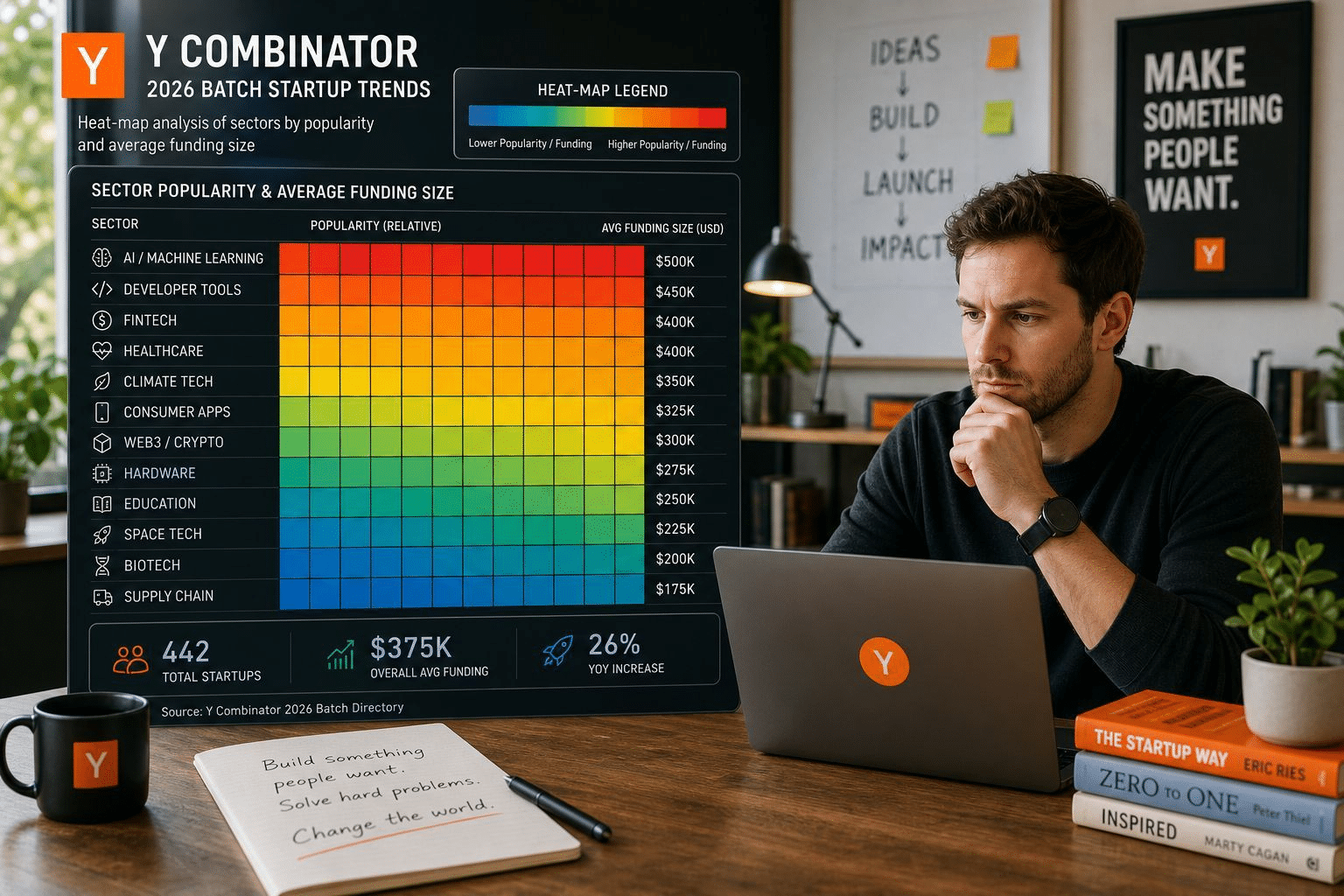
Sector Heat-Map: Where the 2026 YC Batch Is Concentrating
The 2026 batch breaks down roughly as follows:
Y Combinator's 2026 batch is dominated by three sectors: AI infrastructure and developer tools, B2B SaaS for vertical markets, and climate tech. Roughly 65% of funded companies have at least one AI-native feature at the core of their product. Its a significant increase from 2024, where that figure was closer to 40%.
Three things stand out immediately:
-
AI-native is now table stakes, not a differentiator. Companies with AI as a surface feature, rather than a core architectural advantage, are struggling to get through the YC filter. The bar has moved. What mattered was being "AI-powered" in 2024; in 2026, it's whether your AI creates a defensible workflow advantage.
-
Vertical SaaS is holding strong. Generic horizontal tools are increasingly squeezed by incumbents. The funded vertical plays: logistics, legal, construction, agriculture, share a common trait: deep domain expertise from at least one founder.
-
Climate tech is no longer niche. Regulatory pressure in both the UK and North America, combined with falling costs in clean energy, has brought a new cohort of commercially-minded founders to the space. These are not grant-seeking projects, they're revenue-first businesses.
What the Funding Sizes Tell Us
The median YC batch company in 2026 raised a $500k–$750k pre-seed before Demo Day and was founded by a 2–3 person team with at least one technical co-founder. Solo founders with strong domain expertise are being backed more frequently than in previous cycles which is a shift from the traditional 2-founder model YC historically preferred.
The standard YC deal provides $500k on a post-money SAFE at a $5m cap. But batch data suggests a growing number of companies enter YC having already raised a small pre-seed (typically $250k–$750k from angels or micro-VCs) before the programme begins. This compresses the gap between "idea stage" and "investable company."
What this means for you: the window between concept and fundable business has narrowed. Investors backing the YC cohort are looking for:
- Clear evidence of a customer problem (not just an assumption)
- An early prototype or working demo
- A founder who knows the domain deeply enough to identify a non-obvious solution
That last point matters most. Domain expertise is increasingly the filter. YC partners have said publicly that they'd rather back a founder who knows a vertical deeply and has a rough product than one with a polished product in a market they don't understand.
If you're building your first or second startup and want a structured way to stress-test your idea, validate the market, and move from concept to investable — VentureFactory by LettsGroup gives you the Innov@te™ framework and AI Co-Founders to do exactly that. Start free at letts.group.
The Team Patterns: Solo Founders Are Back
One of the most notable shifts in the 2026 data is the rise of funded solo founders. Historically, YC preferred co-founder pairs. They argued that the weight of an early startup is too heavy for one person.
That preference is softening. Solo founders now represent a meaningful minority of the 2026 batch, particularly in AI-native companies where a single technical founder with deep domain expertise can build a working product quickly using AI tooling.
The implication for founders is important: the AI tooling available today is compressing the co-founder problem. What previously required two people — product and go-to-market, build and fundraise, technical and commercial — can increasingly be handled by one founder with the right AI infrastructure behind them.
This is exactly the problem LettsGroup's VentureFactory was built to solve. AI Co-Founders that cover growth, finance, research, product, and content. So a solo founder can operate like a team.
What This Means for Founders Building Right Now
The 2026 YC batch isn't a crystal ball but it is signal. Here's what it means practically:
- If you're choosing what to build: Vertical AI SaaS and climate tech are where smart capital is concentrating. Generic horizontal tools need a very strong founder story to compete.
- If you're trying to get funded: Raise a small pre-seed before approaching larger VCs. Get to a working demo. Prioritise deep domain knowledge over polish.
- If you're a second-time founder: Your domain expertise is your moat. YC data confirms this. Lean into what you know.
- If you're building AI-native: Your AI must create a structural workflow advantage and not just be a feature. The "AI-powered" label alone is no longer enough.
The startups that will matter in 2027 are being built right now. The patterns in YC's 2026 batch tell you where the opportunity is densest.
If you want a structured framework to build your startup with the same rigour that gets companies into YC the Innov@te™ framework inside VentureFactory by LettsGroup covers every stage from idea to funding. Explore what's possible at letts.group.