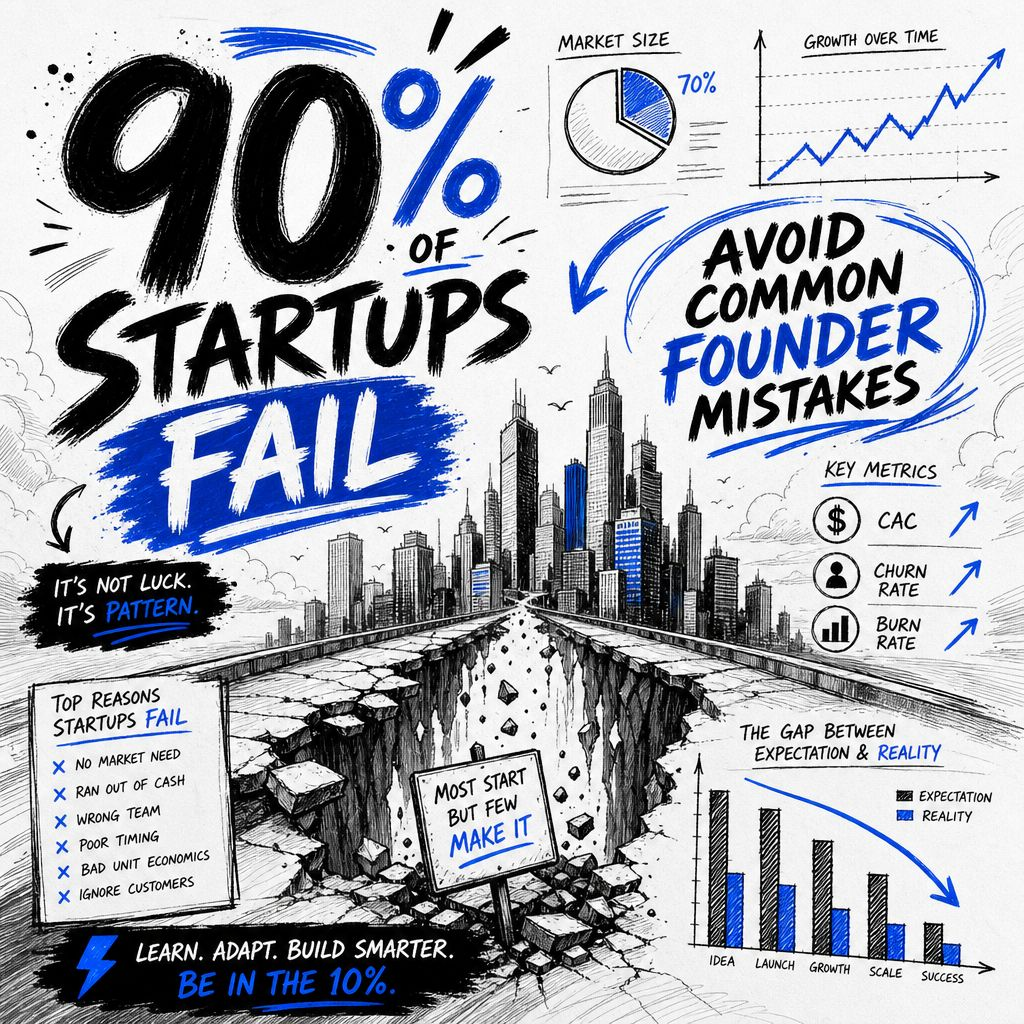
You've probably heard the statistic. 90% of startups fail.
It's repeated so often it's almost lost its power to shock. But if you're a first-time founder sitting with an idea you believe in — a problem you've lived, a product you're certain the market needs — that number should still stop you cold. Because most of those founders didn't fail for the reason you'd expect. It wasn't a bad idea. It wasn't bad luck. It was something far more preventable — and if you know how to build a startup with AI and the right structure behind you, you can sidestep the biggest traps before they cost you. Here are the three things that actually prevent startup failure — and what smart founders are doing differently in 2025.
---
1. They Validate Before They Build
The most common reason startups fail? They build something nobody wants.
CB Insights data consistently shows that "no market need" is the single biggest killer of startups — accounting for 35% of all failures. Founders spend months (and sometimes hundreds of thousands of pounds) building a product before they've confirmed that real people will pay for it.
This sounds obvious in retrospect. In the moment, it feels like the opposite of progress to slow down and test before building.
Founders who survive this trap do three things differently:
- They talk to potential customers before writing a single line of code.** Not surveys. Real conversations, where you ask people to describe the problem in their own words.
- They look for evidence of existing spend.** If your target customer is already paying for an inadequate solution, the market exists. If they're not paying anything at all, you need to understand why.
- They set a clear validation threshold before they start.** "I'll build this when 10 people agree to pay £X before it exists" is a much stronger signal than "loads of people told me it sounded interesting."
Knowing how to build a startup with AI tools means you can run this validation process faster and more systematically — with structured frameworks guiding you through the right questions in the right order, rather than figuring it out by instinct.
---
2. They Build the Right Functions in the Right Order
Second-time founders know something first-timers often don't: the order you do things matters as much as what you do.
Most first-time founders try to run everything simultaneously. Product. Marketing. Legal. Finance. Fundraising. They end up making decisions in the wrong sequence — spending money on a product before validating the model, raising a round before the unit economics make sense, hiring before the core process is documented.
The result isn't just inefficiency. It's structural fragility. A startup built in the wrong order has problems baked in at every layer.
Structured venture-building methodology — the kind that elite accelerators like YC use to guide their cohorts — solves this by stage-gating your progress. You complete the right work at each stage before moving to the next. Problem validation before solution. Business model before marketing. Investor narrative before fundraising.
Learning how to build a startup with AI now means having access to that structured methodology without needing to get into YC to access it. Platforms like VentureFactory apply the same stage-gated approach across every function — product, legal, finance, growth, team — so you're always building in the right order.
---
3. They Don't Try to Be the Expert in Everything
Here's the thing nobody tells you about building a startup: you're going to need expertise in five or six functions simultaneously, and you probably have deep expertise in one.
That's not a criticism. It's just the reality of what a startup demands.
The founders who survive this — who build something that actually scales — are the ones who figure out how to access the right expertise at the right time without burning their entire runway on advisors and consultants.
Historically, that meant one of three options:
1. "Join an accelerator " — competitive, equity-diluting, and available to a tiny fraction of applicants
2. "Hire fractional advisors" — expensive (£3k–£15k per month, per function) and fragmented
3. "Figure it out yourself" — slow, error-prone, and the reason most first-timers burn 18 months learning lessons they could have skipped
In 2025, there's a fourth option: AI co-founders that cover every function.
Knowing how to build a startup with AI means you're no longer choosing between going it alone or spending money you don't have. You get structured, expert-level guidance across product strategy, financial modelling, legal setup, growth planning, and investor readiness — from day one, at a fraction of the cost of any of the alternatives.
---
The Bottom Line
The 90% failure rate isn't fate. It's a pattern — and patterns can be broken once you know what drives them.
The founders who make it validate relentlessly before building. They follow a structured methodology that tells them what to do and when. And they find smart, cost-effective ways to access expertise across every function without diluting their equity or burning their runway.
That's exactly what VentureFactory is built for.
It's an all-in-one AI platform for first and second-time founders in the UK and North America. One subscription. Every function — from idea validation to investor readiness. No equity taken. No long application. No minimum viable network required.
If you're serious about building — and serious about not becoming part of that 90% — start your free trial today.
Try VentureFactory free at letts.group
---
#startup failure, #how to build a startup with AI, #first-time founder, #AI startup tools, #venture building