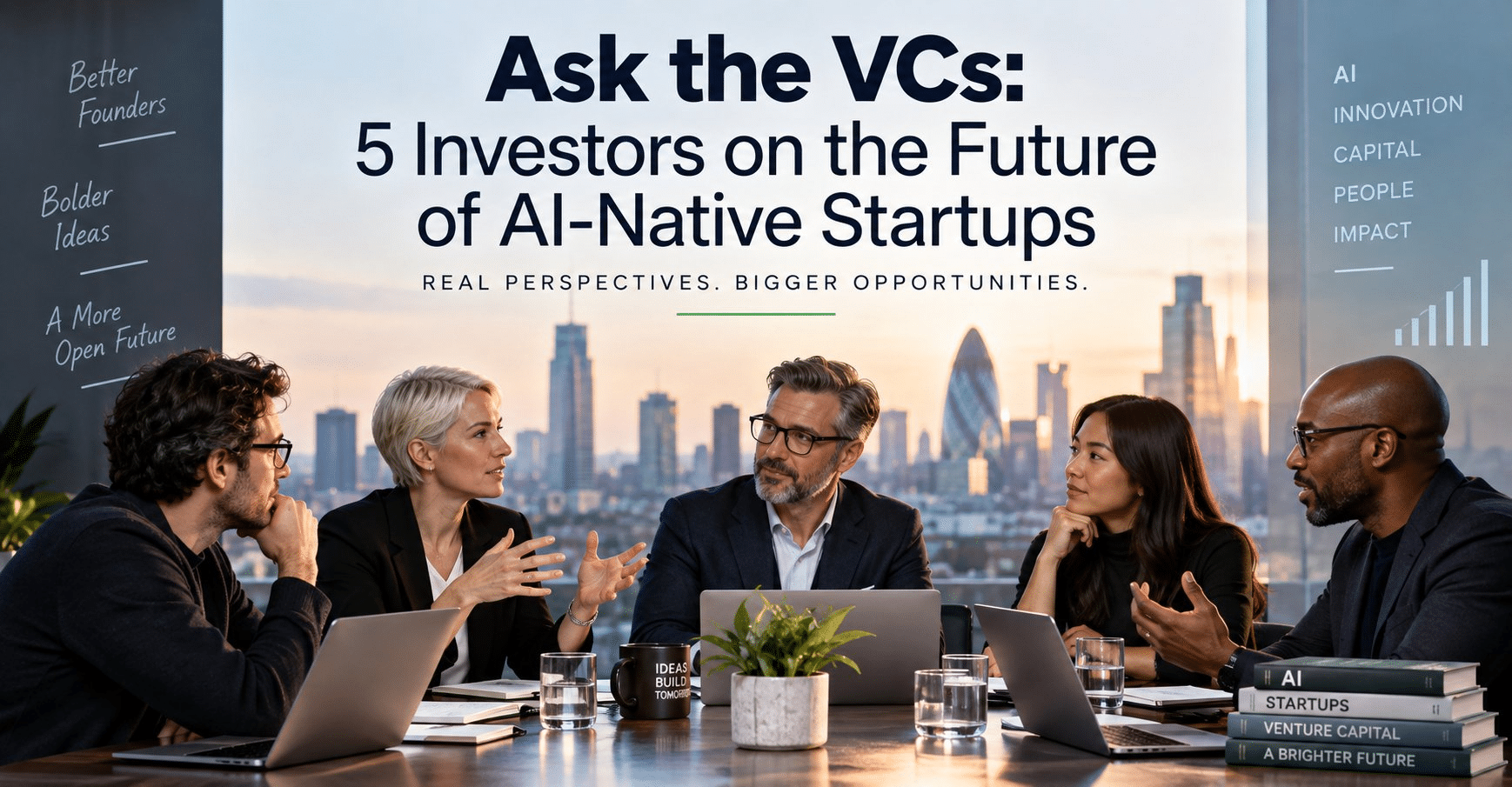
Most founders raising in 2026 are trying to figure out the same thing: what do investors actually want right now? Not what they say on panels — what they're genuinely excited by, what makes them pass, and where they think AI startup investment is heading. We put that question to five active investors — seed to Series A — across the UK and North America. Here's what they told us, in plain language, with the implications for founders building AI-native businesses today.
AI-native startups are businesses where artificial intelligence is embedded into the core product and operations from day one — not added later. In 2026, VCs are prioritising founders who can demonstrate defensible AI workflows, strong unit economics, and domain-specific data moats rather than relying on general-purpose AI tools alone.
What Are Investors Actually Looking for in AI Startups Right Now?
The consensus across all five investors was clear: the "AI wrapper" era is over. Slapping a GPT API onto an existing workflow and calling it an AI company no longer cuts it.
Investor 1 — London-based seed fund (pre-seed to £2M):"We want to see proprietary data loops. If your product gets smarter the more customers use it, that's a moat. If you're just prompting the same models as everyone else, you don't have a business — you have a feature."
Investor 2 — New York, early-stage generalist (€500k–€5M):"The question I ask every AI founder now is: what happens to your product when OpenAI ships something similar? If the honest answer is 'we'd be in trouble', that's a red flag. The best AI companies are building on top of AI, not dependent on it."
Investor 3 — UK deep-tech VC (£1M–£10M, Series A):"I'm excited about AI-native startups in regulated sectors — legal, finance, healthcare. The compliance complexity is a natural barrier to entry. If you can navigate it and move fast, the incumbents can't touch you for three to five years." The pattern emerging from AI startup investment in 2026: defensibility, domain specificity, and genuine operational advantage — not novelty.
What Kills a Deal? The Red Flags Investors Are Seeing
Just as useful as what attracts capital is what ends conversations. Three themes came up repeatedly.
1. No unit economics story
"If a founder can't tell me their CAC, their LTV, and how those numbers change at scale, I stop listening," said Investor 4 (US-based, climate-tech focus). "It doesn't matter how exciting the AI is — if the business model doesn't work at 10x your current size, it's a hobby."
2. Founder over-reliance on AI output
Investor 5 (UK accelerator alumni fund) flagged something more subtle: "We've seen founders who've used AI tools to build everything — the pitch, the financial model, the market research — but they can't defend any of it under questioning. AI should amplify your thinking, not replace it."
3. Team gaps without a plan
"Solo founders are fine at pre-seed if they have a roadmap for the team they're building," said Investor 2. "What concerns me is when someone says 'I'm the technical and commercial lead' and has no answer for how that changes when they need to scale." If you're building with LettsGroup's VentureFactory and using the Innov@te™ framework to structure your venture, these red flags map directly to work you're already doing — financial modelling, team planning, and validation are built into the process.
Ready to build investor-ready from day one? VentureFactory gives you the structure, tools, and AI Co-Founders to prepare your raise properly — start free at letts.group
Where Is AI Startup Investment Heading in the Next 12 Months?
Investors are increasingly distinguishing between startups that use AI as a feature and those built entirely around AI as the operating model. The latter command higher valuations because they scale with fewer people, generate proprietary data, and compress the time from idea to market — making them fundamentally more capital-efficient than traditional software businesses. The five investors we spoke to were broadly aligned on three directions:
1. Vertical AI will dominate seed deals
General-purpose AI plays are harder to fund at seed because the differentiation story is weak. Vertical AI — focused on one industry, one workflow, one pain point — is where investors are concentrating. Think AI for procurement in SMEs, AI for clinical note-taking, AI for legal document review.
2. Capital efficiency is the new growth metric
"We used to ask 'how fast are you growing?' Now we ask 'how much growth per pound invested?'" said Investor 3. AI-native companies that grow revenue without proportional headcount growth are the businesses commanding the best valuations in 2026.
3. The AI stack will consolidate
Investor 1 put it bluntly: "There are too many point solutions. The next wave of fundable companies are the ones aggregating AI tools into coherent workflows for specific buyer types." This is exactly the category LettsGroup sits in — a platform that replaces a fragmented stack of 12 tools with one AI-native system for founders.
What This Means for Founders Raising in the Next 6 Months
Here's the actionable takeaway from five candid investor conversations:
- Lead with your data story — what proprietary signals does your product capture that no one else can access?
- Know your unit economics cold — CAC, LTV, gross margin, payback period. Don't let your AI Co-Founder know them better than you do.
- Build the team narrative — even solo, show investors who joins you at what stage and why.
- Choose a vertical and go deep — broad AI plays are harder to fund; specific domain expertise + AI is the winning combination.
- Demonstrate capital efficiency — show how AI reduces your operational cost base at scale.
The best thing a founder can do before raising AI startup investment in 2026 is to demonstrate that their business model is defensible without the AI — and then show how the AI makes it ten times better. Investors fund businesses, not demos. If the fundamentals are strong, the AI layer amplifies the story rather than being the whole story.
Build an Investor-Ready Startup with VentureFactory
The investors we spoke to are funding founders who've done the work: the validation, the financial modelling, the go-to-market thinking, the team structure. That's exactly what the Innov@te™ framework inside VentureFactory is built to help you complete — systematically, with AI Co-Founders at every stage. You don't need to spend £100k on advisors and consultants to show up investor-ready. You need a platform that builds the rigour in from the start.
Start free at letts.group — and build the kind of business these investors actually want to back.