Congratulations, Humanity. Your Competitive Advantage Is Judgement
30 September 2026
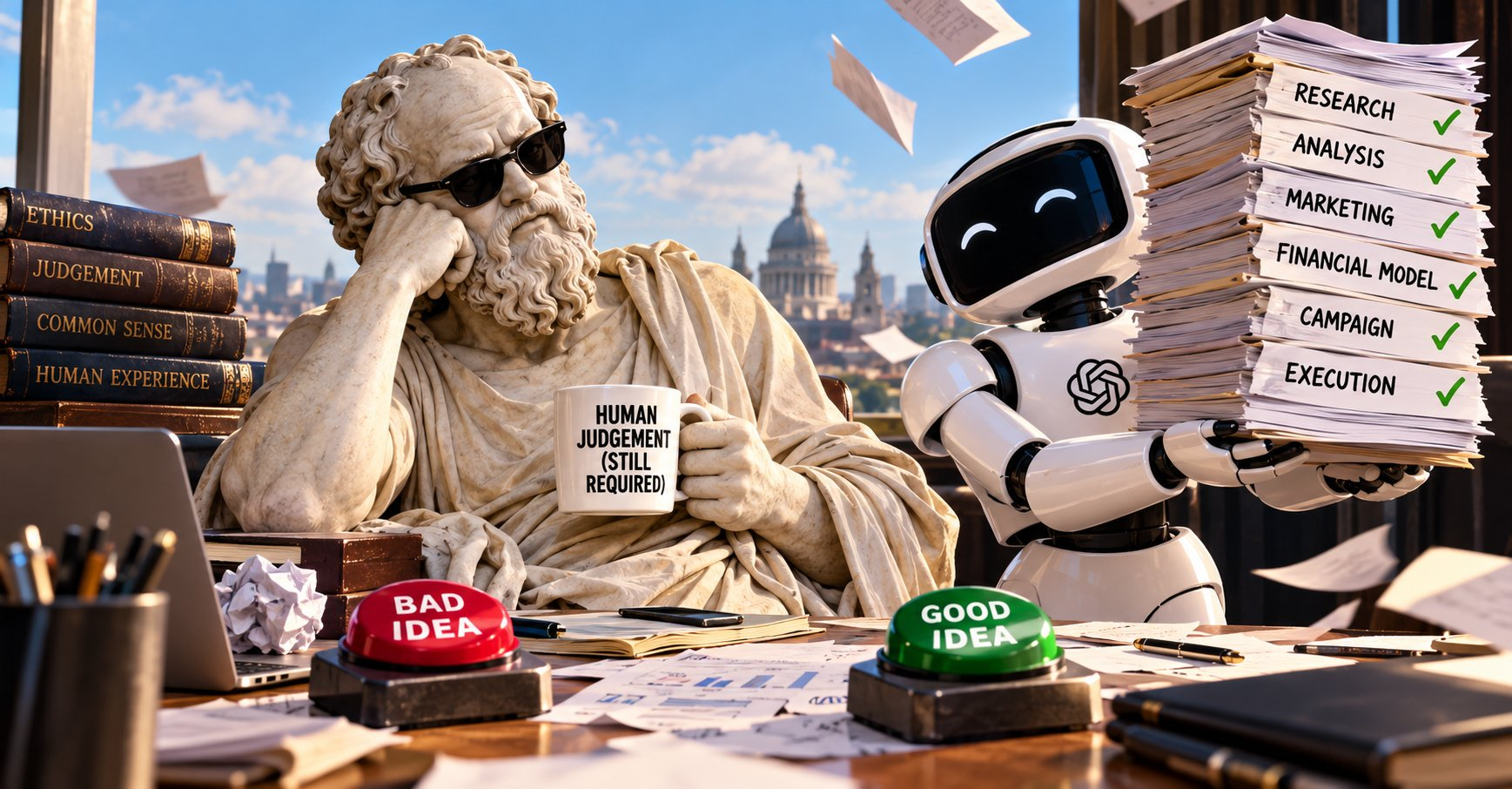
For several thousand years, humanity has been attempting to remove human beings from anything tedious. We invented writing because memory was unreliable, spreadsheets because arithmetic was exhausting, SatNav because nobody wanted to admit they had missed the turning, and management consultants because apparently PowerPoint required a priesthood. Artificial intelligence is merely the latest and most ambitious stage of the project.
There is, however, a small problem. The machines have become astonishingly good at doing things while we remain inconveniently responsible for deciding which things are worth doing.
AI can research a market, interrogate customer data, construct a financial model and produce enough marketing copy before lunch to make the entire communications department reconsider its mortgage. It can take a founder's questionable assumption and execute against it with a speed and enthusiasm previously available only from an extremely expensive consultancy.
Which is wonderful, provided the assumption wasn't idiotic.
The Revenge of the Philosophy Department
One of the more enjoyable developments in artificial intelligence is that some of the world's most technologically sophisticated companies have discovered they need philosophers.
This is quite a turnaround for a profession whose commercial proposition has traditionally consisted of being asked at dinner parties what exactly one intends to do with a philosophy degree. Anthropic has philosopher Amanda Askell working on the behaviour and character of Claude. Google DeepMind employs Henry Shevlin with the magnificent job title "Philosopher". Silicon Valley spent decades making fun of the humanities and has now reached the awkward stage where it needs someone who has read them.
The reason is revealing. Engineering can tell us increasingly extraordinary things about what a machine can do. It cannot, by itself, settle what the machine should do. Apparently the word "should" has survived the GPU.
Socrates Saw This Coming, Obviously
Technology panic is considerably older than technology journalism. In Plato's Phaedrus, Socrates recounts the story of Theuth presenting writing as an invention that would improve wisdom and memory. King Thamus worries that people will instead outsource memory to external marks and acquire the appearance of wisdom without the reality.
It is an excellent story because civilisation's first recorded complaint about information technology was essentially that it would make everybody stupid. We know this because somebody wrote it down.
Humanity has been repeating the performance ever since. New technologies arrive accompanied by predictions that they will liberate civilisation or destroy it, sometimes from the same people and occasionally in the same podcast.
AI deserves something more useful than either response. It is an extraordinarily capable tool, and the interesting question is what happens when execution becomes abundant while judgement remains stubbornly scarce.
AI Has Invented the High-Speed Mistake
Human judgement is a thoroughly inefficient business. It develops partly because we remember getting things wrong. You price something too cheaply and regret it. You hire the brilliant candidate everyone warned you about. You build the feature customers demanded and discover that apparently none of them meant enough to pay for it. Eventually this collection of embarrassments acquires sufficient density to be renamed "experience".
AI doesn't need the embarrassment.
That is both its strength and its limitation. A model can analyse fifty customer interviews and identify the feature mentioned most often. The founder still has to decide whether frequency means importance. It can produce an immaculate financial forecast, but somebody has to notice that the beautifully formatted assumptions underneath it belong in the fiction department.
The great productivity story around AI is therefore slightly incomplete. We have become very interested in how quickly AI allows us to execute and rather less interested in what happens when the thing being executed is wrong. A founder chooses the wrong customer and AI can now research that customer, develop the positioning, produce the campaign and construct a magnificent forecast showing the glorious future awaiting a business nobody needs.
The machine hasn't failed. It has performed beautifully. We have simply invented a much faster way of arriving at the wrong answer.
Keep the Human. Lose Some of the Work.
This is why judgement becomes more valuable as AI becomes more capable. When producing the work was difficult and expensive, execution consumed much of the organisation's attention. As execution becomes cheaper, deciding what deserves to be executed carries more weight.

When intelligence becomes judgement, and judgement becomes action.
That principle sits behind what we're building at LettsGroup with VentureFactory. AI Co-Founders can do substantial work across a venture, while the founder retains control over the decisions that determine where the company is actually going. The point isn't to protect founders from AI or preserve pointless human labour as some sort of heritage craft. It is to use machines for the things machines are becoming exceptionally good at without confusing capability with wisdom.
There is a surprisingly optimistic conclusion buried underneath all the anxiety about AI. Humans have always built tools that extend what humans can do. AI may turn out to be an unusually powerful one, giving a single founder access to capabilities that once required an organisation behind them. That does not make the founder irrelevant. It makes the quality of the founder's decisions more consequential.
Perhaps that will be humanity's slightly humiliating role in the AI economy. The machines will remember more than us, calculate faster than us and produce in seconds what takes us hours. We will still have to look at what they produce, consider the evidence, remember the mistakes, distrust the suspiciously beautiful spreadsheet and ask the oldest and most irritating human question of all: yes, but is this actually a good idea?
Build with AI while keeping the decisions that matter human. Try LettsGroup's AI VentureFactory.