Raising your first or second round is stressful enough without getting lost in instrument mechanics. Convertible notes and SAFEs are both designed to delay the valuation conversation until you have more traction but they are not the same thing, and choosing the wrong one can cost you time, money, and cap table clarity.
Here is a plain-English breakdown of how each one works, where each one wins, and how to decide.
What Is a SAFE?
A SAFE (Simple Agreement for Future Equity) is a simple, founder-friendly financing instrument that converts into equity at a future priced round. It has no interest rate, no maturity date, and no debt. It was created by Y Combinator and is now the default early-stage financing tool in the US and increasingly common in the UK.
The core terms you will negotiate:
- Valuation cap — the maximum company valuation at which the SAFE converts. Lower cap = better deal for the investor.
- Discount rate — the percentage reduction on the share price at conversion (typically 10–20%).
- MFN clause — "Most Favoured Nation" gives the SAFE holder the right to match better terms offered to future investors.
Most early-stage SAFEs today use a valuation cap only, with no discount. This is the Y Combinator post-money SAFE structure. It's the one most US and UK angels now expect.
Where SAFEs work best:
- Pre-seed rounds under £500k / $500k
- US-based investors (it is their default instrument)
- Fast-moving rounds where you do not want legal complexity
- Founders who want to avoid the word "debt" in conversations
What Is a Convertible Note?
A convertible note is a short-term loan that converts into equity at a future funding round. It accrues interest (typically 5–8% per year), has a maturity date (usually 12–24 months), and is technically debt until conversion. It is more commonly used in the UK and can offer more negotiating flexibility than a SAFE.
The core terms:
- Interest rate — accrues until conversion; adds to the principal that converts.
- Maturity date — if you have not raised a priced round by this date, the note holder can demand repayment (or convert at a negotiated rate). This is a real pressure point.
- Valuation cap — same concept as with a SAFE.
- Discount rate — same concept as with a SAFE.
- Conversion triggers — what events cause the note to convert (typically a qualified financing above a minimum threshold).
Where convertible notes work best:
- UK rounds where investors are more familiar with the debt structure
- Situations where you need the interest accrual to incentivise early commitment
- Rounds where investors want the maturity date as a backstop
Side-by-Side Comparison
Rather than lining these up as a checklist, here's how they actually diverge, one feature at a time:
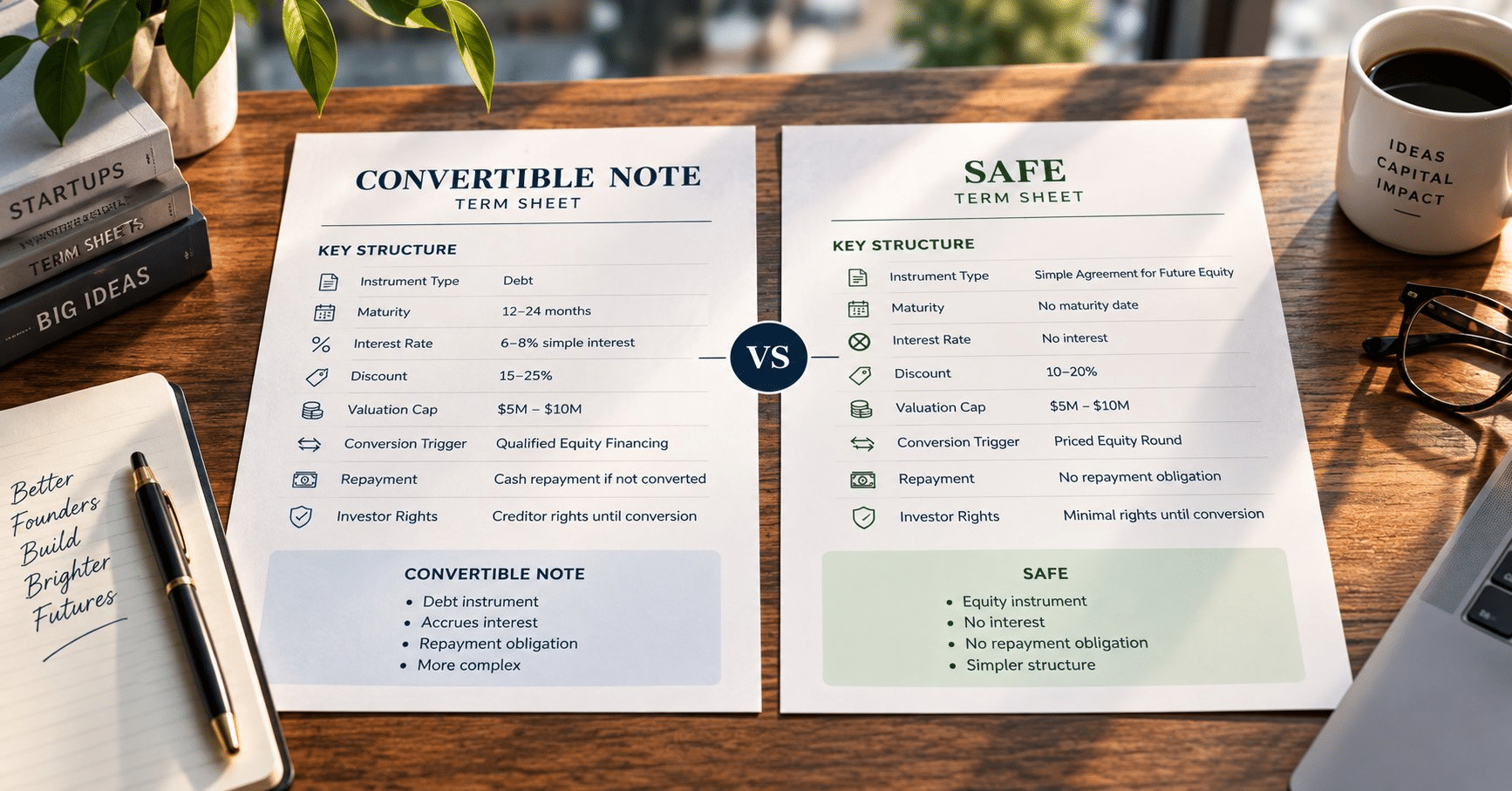
Legal structure. A SAFE is an equity instrument no debt is ever created. A convertible note is a short-term loan; until it converts, it sits on your balance sheet as debt.
Interest. SAFEs carry none. Convertible notes accrue interest, typically 5–8% a year, which adds to the principal that converts into shares.
Maturity date. SAFEs have none. There is no clock forcing a conversion event. Convertible notes carry a maturity date, usually 12–24 months out, after which the holder can demand repayment or a negotiated conversion. That date is a real deadline you are signing up for.
Complexity. A SAFE is close to a one-page document. A convertible note carries more negotiated terms around interest, maturity, conversion triggers and more moving parts for your solicitor to review.
Investor familiarity. In the US, SAFEs are the default and almost universally understood; in the UK they are still gaining ground. Convertible notes are the reverse. They are long-established in the UK, and familiar enough to US investors too.
Founder-friendliness. SAFEs tilt in the founder's favour with no debt and no maturity pressure. Convertible notes are workable, but the maturity date hands the note holder a point of leverage a SAFE holder simply doesn't have.
Typical round size. Both show up at pre-seed and seed. Convertible notes also turn up in bridge rounds, where the maturity-date mechanic is sometimes exactly what both sides want.
UK legal recognition. Convertible notes are well established under UK law. SAFEs are catching up but remain the newer instrument here. You would need to get proper English-law drafting if you use one.
Which Should You Use?
The honest answer: it depends on your investor base and geography.
If your investors are US-based angels or VC funds or UK investors who follow US deal norms go with a SAFE. It is simpler, faster, and has no debt overhang. Y Combinator's post-money SAFE documents are free, widely understood, and take a day to execute.
If your investors are UK-based and expect the HMRC-friendly convertible loan note structure (which can carry EIS/SEIS tax relief advantages), a convertible note may be the right call. Talk to your solicitor as the tax implications for your investors can meaningfully affect how easy your round is to close.
Three questions to ask yourself before deciding:
- Where are my investors based, and what instrument do they usually use?
- Am I comfortable with a maturity date creating a time pressure on my next raise?
- Do my investors need SEIS/EIS tax relief? (If yes, the instrument structure matters.)
If you're building your first or second startup, VentureFactory gives you a structured financing document builder that walks you through both instruments — start free at letts.group
Watch Out for These Common Mistakes
Even founders who understand the instruments get caught by the details.
Cap table dilution at conversion. A SAFE or note converts into shares at your next priced round. If you have issued multiple SAFEs with different caps, the dilution can be more than you expected. Model it before you sign anything.
Stacking too many uncapped instruments. An uncapped SAFE with a high MFN clause can give your early investor a surprisingly large slice at conversion. Always understand the conversion maths.
Ignoring the maturity cliff. If you use a convertible note and your next round takes longer than expected, the maturity date becomes a negotiation you did not plan for. Founders who raise in a slower market sometimes hit this and it is stressful.
Not getting UK legal advice on cross-border instruments. A US-form SAFE may not be treated the same way under UK law as an English-law convertible loan note. If your company is incorporated in England and Wales, use English-law documents or get proper advice.
The Bottom Line
Neither instrument is universally better. A SAFE is faster and cleaner. A convertible note is more familiar to UK investors and can carry EIS/SEIS advantages. The right choice is the one your investors will sign quickly, at terms you can live with at conversion. Model the conversion maths. Know your investor base. Get a good solicitor to review the final document. This is one area where cutting corners costs more later than it saves now.
When you are ready to build your financing documents including valuation cap modelling and investor-ready term sheets VentureFactory has the tools to do it properly. Start free at letts.group