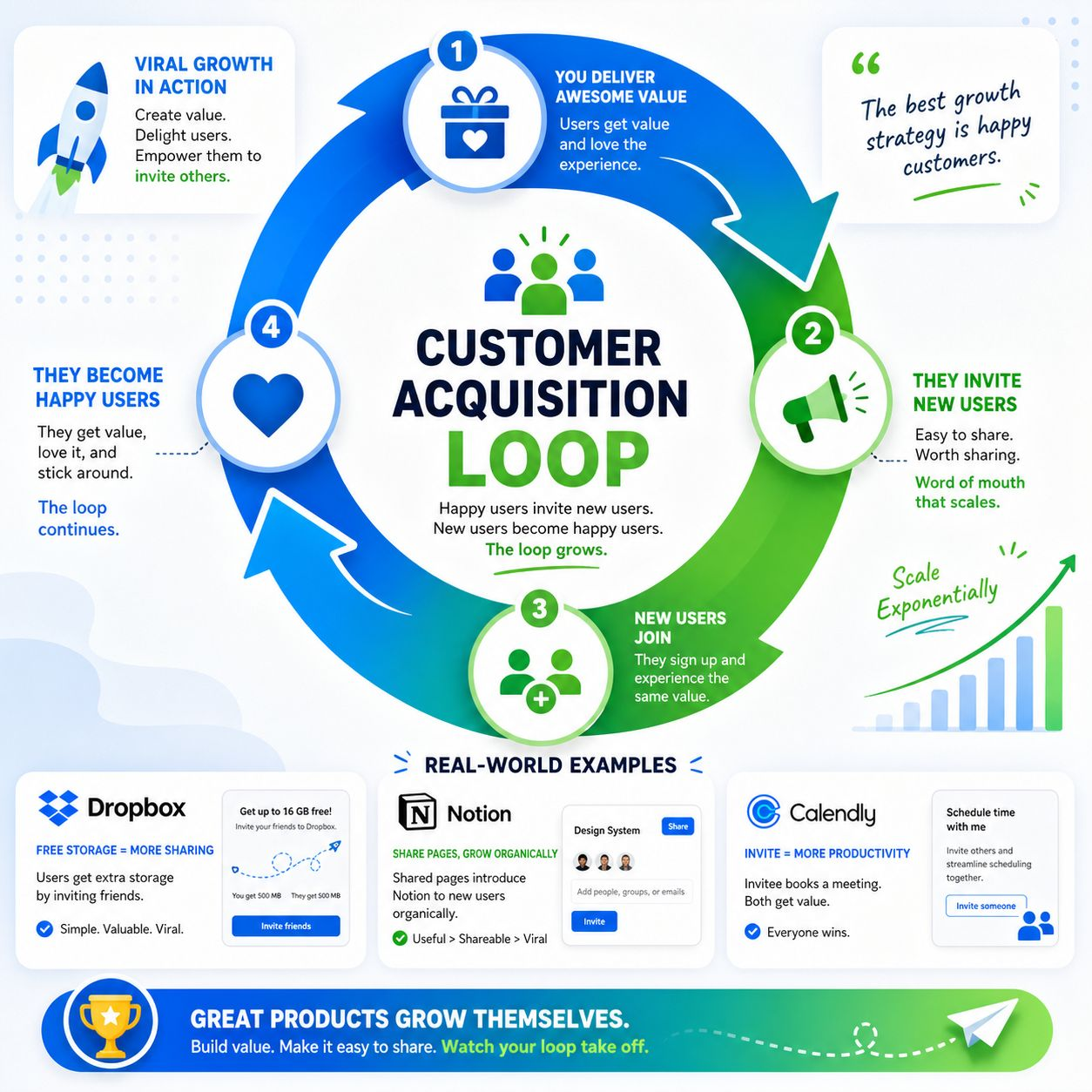
Most early-stage founders think about growth as a funnel: you pour people in at the top, and some come out the bottom as paying customers. Funnels are useful for understanding conversion but they have a ceiling. Every new customer requires you to put more in at the top.
The best growth companies don't just optimise funnels. They build "loops".
A loop is a self-reinforcing system where each customer makes it easier to acquire the next one. Done right, your growth rate accelerates as your user base grows without a proportional increase in acquisition spend. Here's how it works, and how to build your first one.
What Is a Customer Acquisition Loop?
Plain-English Definition: A customer acquisition loop is a repeating cycle where using your product creates a mechanism that brings in new users so growth compounds rather than accumulates linearly.
Think of the difference between a leaky bucket (funnel) and a flywheel (loop). With a funnel, you stop growing the moment you stop pouring. With a loop, momentum builds on itself;
A customer acquisition loop is a self-reinforcing growth mechanism where each new user or customer creates the conditions for acquiring the next one. Unlike a linear funnel, loops compound: the more users you have, the faster you grow. Examples include referral programmes, product-led virality, and user-generated content cycles.
The three most common loop types for early-stage startups are:
Marketplace Real-World Examples: What Actually Worked
Dropbox — The Referral Loop That Defined a Category
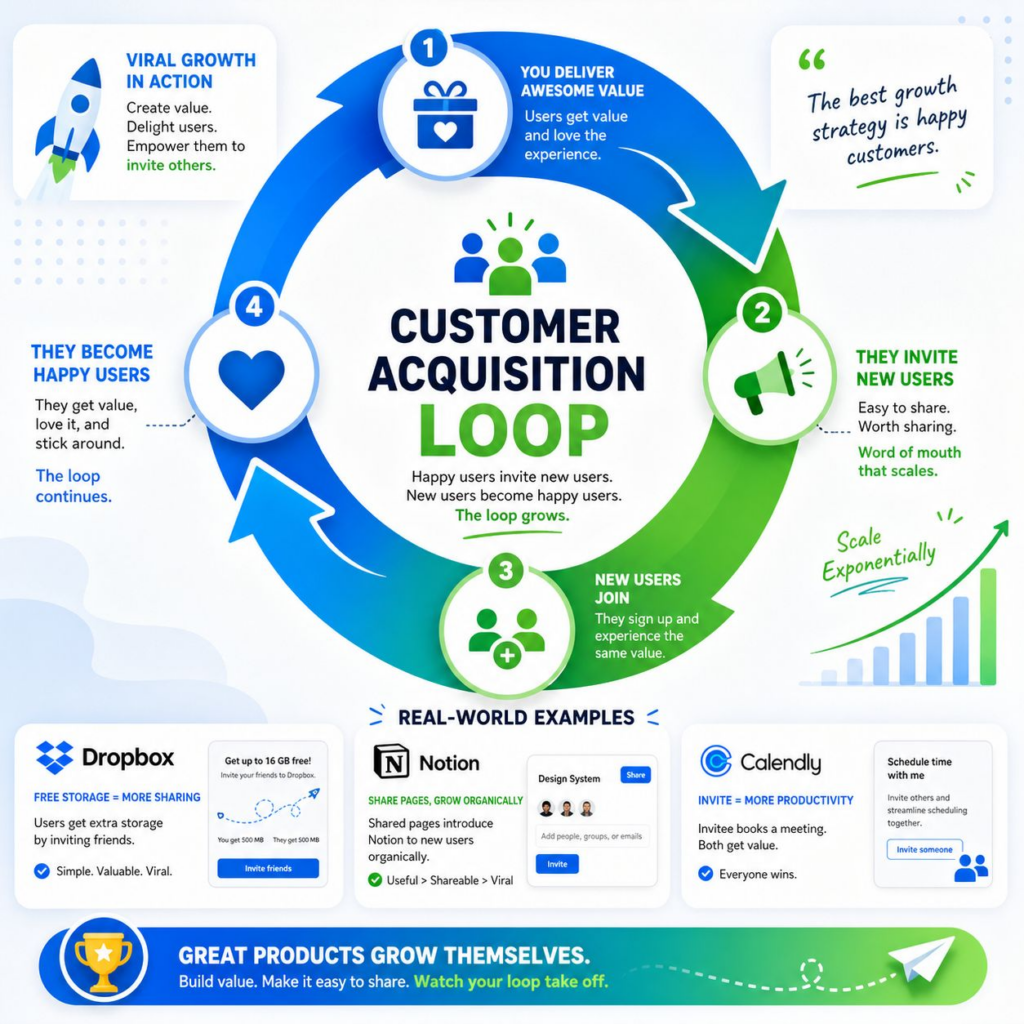
Dropbox's referral programme is the textbook example of an incentive loop. Both the referrer and the new user received additional free storage (500MB each). The mechanic was built directly into the product onboarding — you couldn't miss it.
Dropbox's referral loop gave both the referrer and the new user extra storage space. Every new sign-up had an incentive to invite more people, which compounded their user base without paid acquisition. This single loop reduced Dropbox's customer acquisition cost by 60% and contributed to their growth from 100k to 4 million users in 15 months.
What made it work:
- The reward was directly tied to the core value proposition (more storage)
- Both sides benefited, so it never felt like spam
- The loop was impossible to miss during onboarding not buried in a settings menu
The lesson: Your referral reward should make your product more valuable, not just cheaper. Discounts work; adding value works better.
Notion — The Product-Led Virality Loop
Notion didn't grow through referral incentives. It grew because using Notion exposed non-users to Notion constantly. When a Notion user shared a document, template, or workspace with a colleague who wasn't a user yet, that person had to create an account to engage with it.
Every collaborative action was a passive acquisition event. Notion's viral loop was embedded in normal product behaviour — there was no "invite a friend" mechanic, just a product that required collaboration to get value from.
By 2021, Notion had over 20 million users and had barely run traditional paid acquisition campaigns. The loop did the work.
The anatomy of Notion's loop:
1. User creates content in Notion
2. User shares content with a non-user
3. Non-user must sign up to interact
4. Non-user finds value and creates their own content
5. Repeat
Building a startup and not sure where to start with growth? VentureFactory by LettsGroup (LettsGroup, a UK-based AI-native venture builder) gives seed-stage founders structured growth frameworks powered by the Innov@te™ framework including tools to design and track your first acquisition loop. Start free at letts.group
Calendly — The Scheduling Loop That Sells Itself
Calendly is perhaps the cleanest example of unavoidable product virality. Every time a Calendly user sends a scheduling link, the recipient sees the Calendly interface. At the bottom: "Get your own Calendly."
This is sometimes called a signature loop — every usage event is also a marketing impression. The person booking a meeting becomes a potential user simply by completing the action they were already going to take.
Calendly's loop:
1. User sends scheduling link
2. Recipient books via Calendly interface
3. Recipient sees Calendly branding
4. Some percentage sign up
5. New user sends their own scheduling links
6. Repeat
The brilliance is that Calendly didn't need to build anything extra for this to work. The loop was a natural consequence of how the product functions.
How to Build Your First Acquisition Loop
You don't need Notion's engineering team to build a loop. Here's a practical framework for first and second-time founders:
Step 1: Map Your Usage → Exposure Moments
Ask yourself: when does using my product naturally put it in front of non-users? Write down every touchpoint:
- Shared outputs (documents, links, reports)
- Email footers or signatures
- Invitations to collaborate
- Public profiles or portfolios
- Notifications that reference your product
Pick the one that happens most often. That's where your loop starts.
Step 2: Design the Conversion Mechanism
Once a non-user is exposed to your product, what happens next? You need a clear, frictionless path from "I've seen this" to "I have an account." This means:
- A clear CTA at the point of exposure
- A fast, low-friction sign-up (ideally Google/email one-click)
- An immediate "aha moment" after sign-up that justifies the account creation
Step 3: Add an Incentive (if the Loop Isn't Natural)
If your product doesn't have natural virality baked in (many B2B tools don't), a referral incentive can create an artificial loop. The key rules:
- The reward must relate to the product's core value
- Both sides should benefit (double-sided referrals convert better than one-sided)
- Make the mechanic visible — not buried in a dashboard
Step 4: Measure the Loop Coefficient
Your viral coefficient (K) = (number of invites per user) × (conversion rate of invites). If K > 1, your product is growing purely through the loop. Most products won't hit K > 1 immediately — aim for K > 0.5 as an early milestone. Every fraction of improvement compounds over time.
Apply This With VentureFactory's GrowthGen Module
LettsGroup's VentureFactory platform includes a GrowthGen module within the Innov@te™ framework — a structured AI-powered system for building and tracking growth experiments. Rather than guessing which acquisition loop fits your model, GrowthGen helps you identify your strongest usage-to-exposure moments, design your first loop, and track the coefficient as your user base grows.
Loops Win. Funnels Plateau.
Funnels are not going away. You still need to understand conversion at every stage. But if your only growth strategy is pouring more money into ads, you're on a treadmill. The moment you stop spending, growth stops.
Loops change the equation. They let your existing users do the work of acquiring the next ones. Dropbox, Notion, and Calendly didn't luck into viral growth. They designed it deliberately, from the beginning.
Pick one loop type. Find your usage-to-exposure moment. Build the conversion mechanic. Measure the coefficient. Iterate.
That's how growth compounds.
Ready to design your first acquisition loop? VentureFactory gives you the tools, AI Co-Founders, and structured frameworks to build a startup that grows systematically — not just sporadically. Start free at letts.group