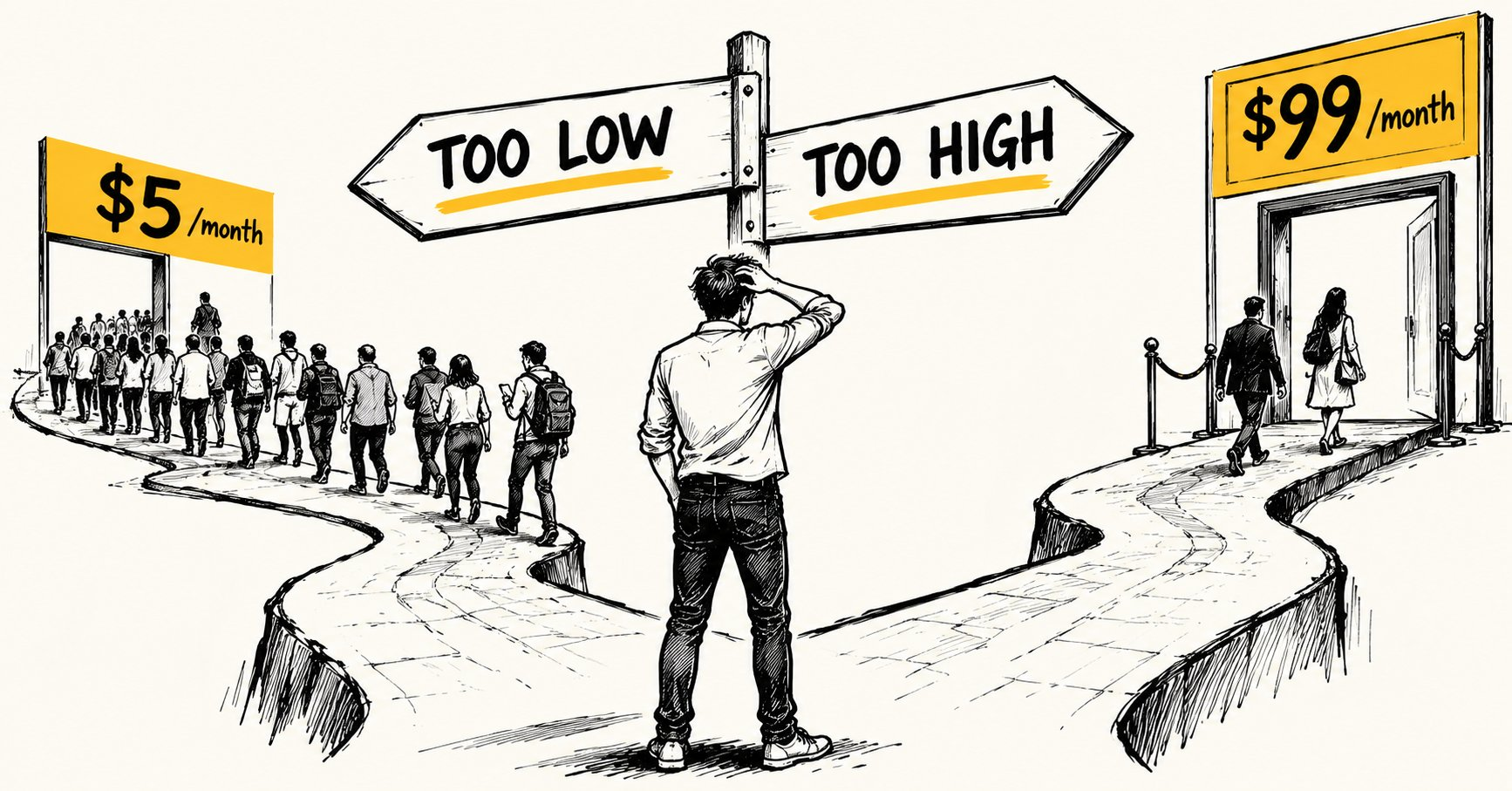
Most founders get SaaS pricing wrong twice.
First, they price too low. They're afraid of rejection, or they copied a competitor who never found the right price either. Then they raise the price and find out who they actually signed up. Customers won at a low price are more price-sensitive and quicker to churn when the number moves. They also give you a distorted picture of the market you're trying to build for.
Both mistakes are avoidable. You don't need a consultant or an A/B testing budget. You need to know what pricing does in your business and what to learn before you pick a number.
What pricing is not
Start with cost-plus: work out what delivery costs, add a margin, charge that. It's a fine sanity check and a bad starting point. Once the infrastructure exists, serving one more customer costs close to nothing. So cost-plus ignores the ceiling, which is the most a customer will pay for the value they get. For most SaaS products the gap between floor and ceiling is wide. Price near the floor and you leave money on the table.
Competitor-based pricing has the same flaw. You can see their prices but not their reasoning. A market leader may be running penetration, land-and-expand or volume-over-margin. None of that applies to a smaller company at a different stage. Copy the number without the reasoning and you're right by luck, or wrong for reasons you can't see.
Value-based pricing: the method that works
Ask what the product is worth to the customer. The answer exists, but you find it by talking to customers, not by staring at spreadsheets.
Run willingness-to-pay conversations. You need no conjoint analysis and no research budget. Talk to ten to fifteen potential customers. Name a price and watch the reaction. Then probe: do they object to the price, or do they doubt the value? That gives you a working range faster than anything else. Add the Van Westendorp meter, four questions on acceptable, expensive, cheap and too-cheap prices. It fits in a thirty-minute conversation and gives useful triangulation.
Stop guessing what customers will pay. VentureFactory helps you test pricing assumptions against real customer evidence before you commit. Start free.
Founders who do this usually find their first instinct was too low. Not always by much. But the most enthusiastic customers tend to be less price-sensitive than assumed. The one who balks is often not the customer you should be optimising for anyway.
The freemium trap
Freemium is one of the most recommended and most misapplied strategies in early-stage SaaS. The appeal is real. There's no price barrier, and the product proves itself before it asks for money.
But it only works when three things are true. The product is obviously valuable to a lot of users. The path from free to paid is short and clear. Free users are cheap enough to serve. Most early-stage products can't claim all three. You end up with a big free base that costs money, conversion below forecast, and a market that has learned your product is free. That's hard to undo.
Freemium is a marketing strategy that happens to involve pricing. It isn't a pricing strategy that happens to produce free users. Before you go there, ask what the free tier is for. Then ask whether a time-limited trial would do the same job without the same cost.
The anchoring decision
Decide which plan most customers should pick. In a three-tier structure, make the middle tier the default. It isn't a compromise between a stripped-down entry tier and a heavyweight enterprise one. It's the product at its most useful for your primary ICP. The entry tier cuts friction. The top tier captures customers whose use case really justifies more. Neither is the point of the business.
The Innov@te framework includes a pricing validation stage that treats price as an assumption to test before it's built into the product. Pricing is one of the most load-bearing assumptions a venture makes, and one of the hardest to change cleanly once the first cohort is paying.
Your pricing should be validated, not borrowed from a competitor. Use the Innov@te Framework inside VentureFactory to test your pricing model and build a stronger SaaS business. Start free, no credit card required.