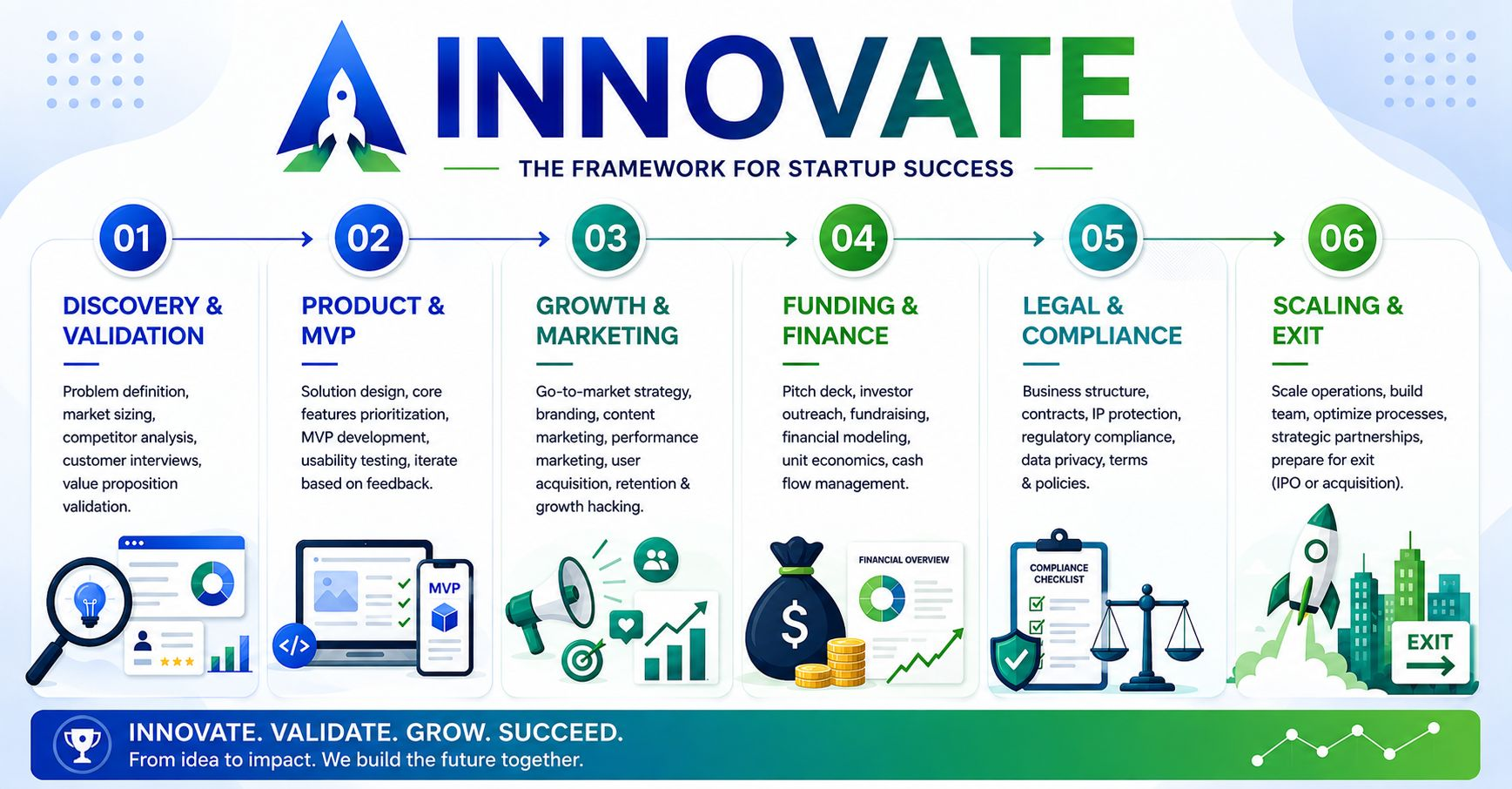
Most AI tools give you a blank page and a text box. LettsGroup, the company behind VentureFactory, does something different: it gives you a structured venture playbook, guided by AI Co-Founders, covering every stage of building a startup from first idea to exit. But how does that actually work under the hood?
This post goes behind the scenes to the data sources, the prompt architecture, the safeguards, and the continuous learning loop that makes VentureFactory different from generic gen-AI startup tools. If you're a founder who thinks in systems, this one's for you.
What Are AI Venture Playbooks?
LettsGroup's AI venture playbooks are structured frameworks trained on startup methodology, real founder patterns, and domain expertise across funding, product, growth, and legal. They power VentureFactory's AI Co-Founders, which guide founders through every stage from idea validation to exit without taking equity.
Definition: An AI venture playbook is a curated, domain-specific framework that tells an AI model what to ask, what to produce, and in what order for a specific phase of building a startup. It is not a general chatbot. It is a structured expert system layered on top of a large language model. Think of it this way: hiring a fractional CFO, a growth consultant, a legal adviser, and a product strategist and having all of them coordinated, always available, and working from the same brief. That's what venture playbooks enable inside VentureFactory.
What Is the Innov@te™ Framework — and How Does It Structure the AI?
The backbone of VentureFactory's AI engine is the Innov@te™ framework, a 49-step structured methodology developed by LettsGroup to guide founders through every meaningful decision from ideation to exit. Each stage in the Innov@te™ framework represents a distinct phase of venture building:
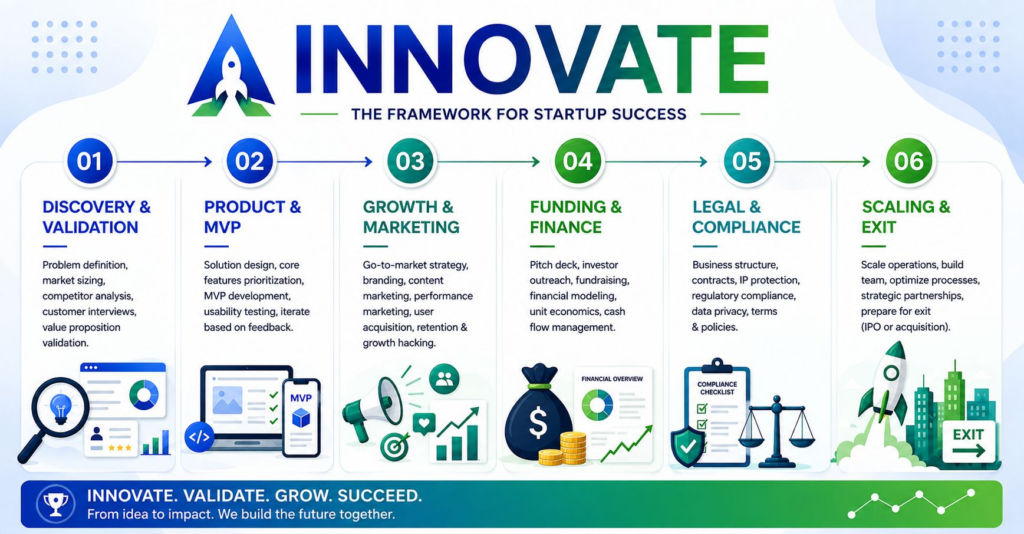
Each stage maps to one or more AI Co-Founders, specialist agents with defined roles, capabilities, and boundaries. When you work through a stage in VentureFactory, the relevant AI Co-Founder activates, pulls the context it needs from your venture profile, and produces a structured, editable output. VentureFactory uses the Innov@te™ framework, a 49-step structured playbook, as the backbone of its AI engine. Each stage is mapped to specific founder decisions, and AI Co-Founders use curated prompt chains and safeguards to produce context-aware, actionable outputs for each startup.
If you want to see the Innov@te™ framework in action for your own startup, start free at letts.group
How the Playbooks Were Built: Data Sources and Training Approach
Building AI venture playbooks that actually work, rather than producing generic startup advice, required a deliberate approach to what goes into them.
1. Structured startup methodology
The Innov@te™ framework draws on established methodologies: lean startup principles, jobs-to-be-done theory, agile product development, SaaS growth mechanics, and UK and North American legal and financial practice. These aren't scraped indiscriminately. They're curated and mapped to specific venture stages.
2. Domain-specific prompt engineering
Each playbook stage uses a prompt chain, a structured sequence of instructions, that constrains the AI to the relevant domain, persona, and output format. A funding-stage prompt behaves very differently from a growth-stage prompt, even though both may use the same underlying model. The prompt architecture ensures that LettsGroup's AI Co-Founders produce specific, structured, usable outputs rather than generic content.
3. Venture context integration
Every output is personalised. When an AI Co-Founder produces a financial model, a pitch deck outline, or a content strategy, it draws on your specific venture profile: on your market, on your stage, on your team, on your numbers. Context is everything. Generic advice is cheap. Context-aware guidance is the product.
4. Iterative refinement
The playbooks are not static. As founders use VentureFactory and provide feedback, explicitly through ratings and edits, and implicitly through usage patterns. The prompt chains are reviewed and refined. This is a continuous improvement loop, not a one-time training exercise.
Safeguards: What the AI Won't Do
VentureFactory's AI Co-Founders operate within defined capability boundaries. Each agent is scoped to its domain and cannot act outside its remit without founder approval. Sensitive actions (sending emails, updating financial records, publishing content) require explicit confirmation. The system is designed to assist and recommend, not to act autonomously without oversight. This matters because the failure mode of most AI tools is overreach. The model confidently produces output that looks right but isn't. VentureFactory's playbook architecture addresses this in three ways:
- Domain scoping: each AI Co-Founder only works within its defined remit. A Growth Co-Founder doesn't rewrite your term sheet. A Legal Co-Founder doesn't draft your landing page copy.
- Approval gates: sensitive actions (sending emails to investors, updating financial data, publishing assets) require explicit founder confirmation before execution.
- Output editability: every output is a starting point, not an instruction. You review, edit, and approve before anything is treated as final. The AI is your co-founder, not your CEO.
The Continuous Learning Loop
VentureFactory is designed to get better over time both at a platform level and for your specific venture. At the platform level, LettsGroup's team reviews playbook performance across anonymised usage patterns. Stages where founders consistently edit outputs heavily are candidates for prompt refinement. Stages with high approval rates and low edit rates signal strong playbook performance. At the venture level, your VentureFactory instance learns your context progressively. As you complete stages, the platform builds a richer picture of your startup — your positioning, your team, your financials, your target market — and subsequent AI Co-Founder outputs become more precisely tailored to your specific situation.
This is the compounding advantage of an AI platform built for startup building, versus a general-purpose AI tool. The more you use it, the better the outputs get for you specifically.
What This Means for You as a Founder
You don't need to understand the technical architecture to benefit from it. But knowing it exists matters — because it tells you that VentureFactory's AI venture playbooks are not a party trick or a glorified template library. They are structured, safeguarded, context-aware frameworks designed by people who have studied how startups succeed and fail. Wrapped in software that makes expert-level guidance accessible to every first and second-time founder, at a fraction of the cost of hiring the advisors who would otherwise provide it. No equity taken. No 6-month accelerator application. No waiting list.
If you're building something and you want to see what structured AI guidance actually looks like in practice, explore VentureFactory free at letts.group