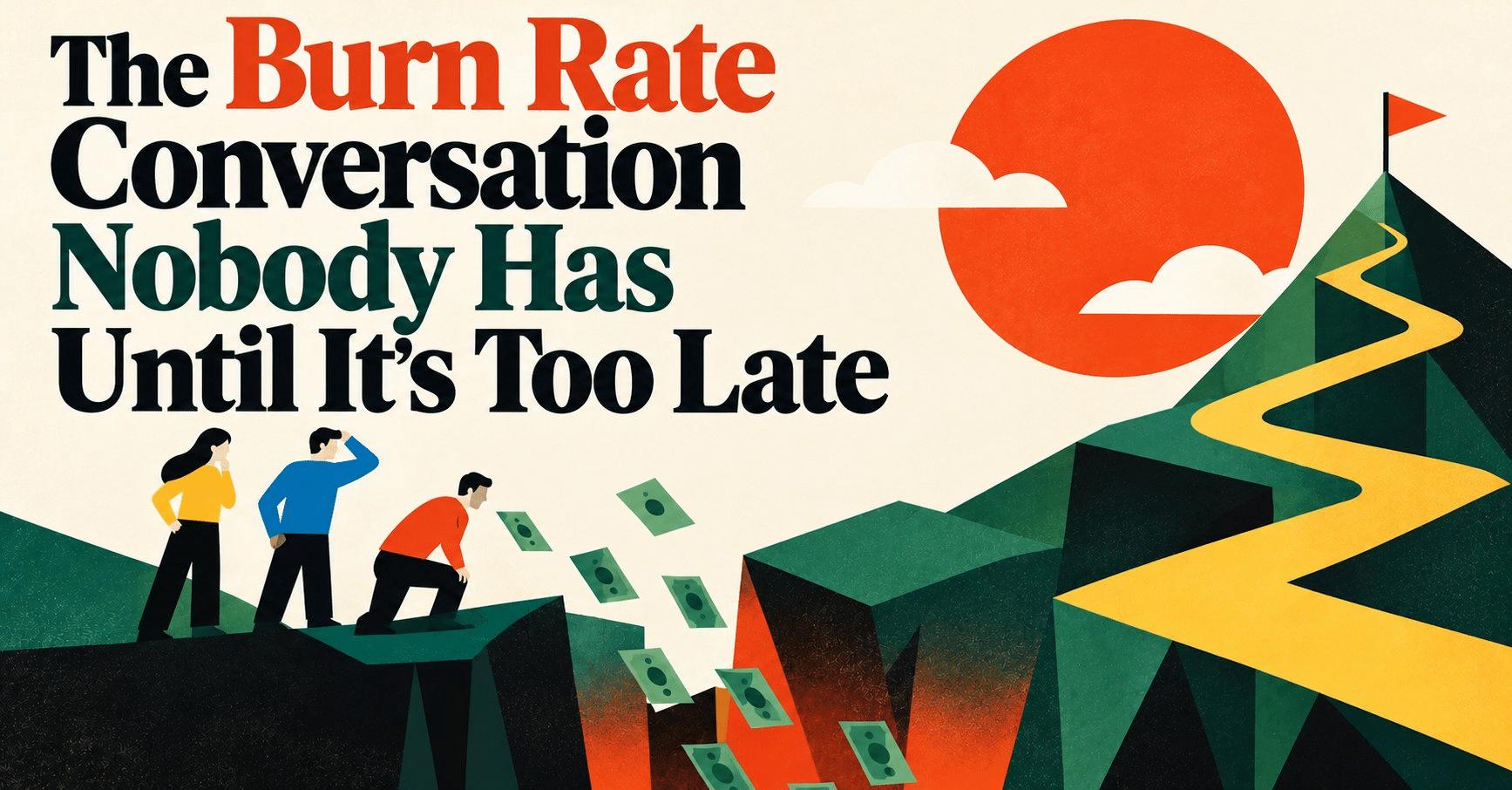
Most founders know their runway number. They can tell you, to the nearest month, how long the company has at its current burn rate before the bank account runs out. What is considerably rarer is a founder who treats burn rate as a live strategic variable rather than a financial constraint they monitor from a distance.
The distinction between these two approaches is not academic. It shapes what gets built, what gets delayed, what gets cut, and ultimately whether the company exists in eighteen months to raise the next round.
What burn rate actually represents
Make every pound of startup spending count. VentureFactory helps you connect financial decisions to the progress your business needs to make. Start free.
Burn rate is not, at its core, a finance number. It is a measure of what the company has decided to do. Every pound leaving the account is the consequence of a prior decision to hire, to contract, to advertise, to build one feature rather than another. The monthly burn figure is the financial shadow of the product and operational decisions the team has been making for the past several months. Understanding it as such changes what questions you ask when it moves.
When burn goes up, the question worth asking is not "can we afford this?" by the time the invoice arrives, that question is already too late. The more useful question is "which decision caused this, and was it the right one?" That is a different kind of reckoning, and it requires a degree of accountability to the decision-making process that most early-stage companies do not formally maintain.
The moment the conversation gets skipped
There is a predictable pattern to how the burn rate conversation gets deferred. A startup in its early months is typically moving fast enough that every individual decision feels justified by the immediate problem it is solving. Hire a developer because the backlog is long. Spend on a channel because the pipeline is thin. Take on a new piece of infrastructure because the current solution is slow. Each decision, in isolation, is defensible. The problem is that they compound, and the cumulative effect of a series of individually justified decisions can produce a burn rate that no one consciously chose.
By the time the monthly figure is large enough to provoke a serious conversation, the decisions that produced it have already been made. The team is now not discussing whether to burn at this rate. Instead they are discussing whether they can sustain it. That is a much weaker position to be reasoning from.
Burn rate as a product decision
The framing that most changes how founders engage with this is treating burn rate not as a finance question but as a product question. What you build determines what you spend. A product team that decides to pursue five features in parallel is making a burn rate decision, whether or not they describe it that way. A founding team that decides to hire ahead of validated demand (banking on a forecast rather than a confirmed signal) is doing the same.
The companies that manage burn most effectively tend to have an explicit connection between their validation pipeline and their spending decisions. Before a resource commitment is made, there is a defined question it is intended to answer. If the question has not been answered yet, the resource commitment waits. This is not always feasible, some investments, particularly people, require long lead times but as a discipline it produces materially different outcomes from a company that spends first and asks the question later.
The structured approach
The Innov@te framework, at its core, enforces this connection. Each stage requires defined validation before the next phase's spend is authorised. Not because the framework is conservative about building, but because the failure mode it is designed to prevent committing resources to assumptions that have not been tested is among the most common causes of startups running out of money before they find their footing.
Burn rate discipline is not about minimising spend. Some of the most valuable things a startup can do cost real money. It is about maintaining a direct, conscious line between what the company is spending and what question that spending is intended to answer. When that line breaks, burn stops being a strategic variable and becomes something that happens to the business rather than something the business controls. By the time founders notice the difference, the gap is usually hard to close quickly.
Don't just track your runway. Make better decisions about how you spend it. Build with the Innov@te Framework inside VentureFactory. Start free, no credit card required.