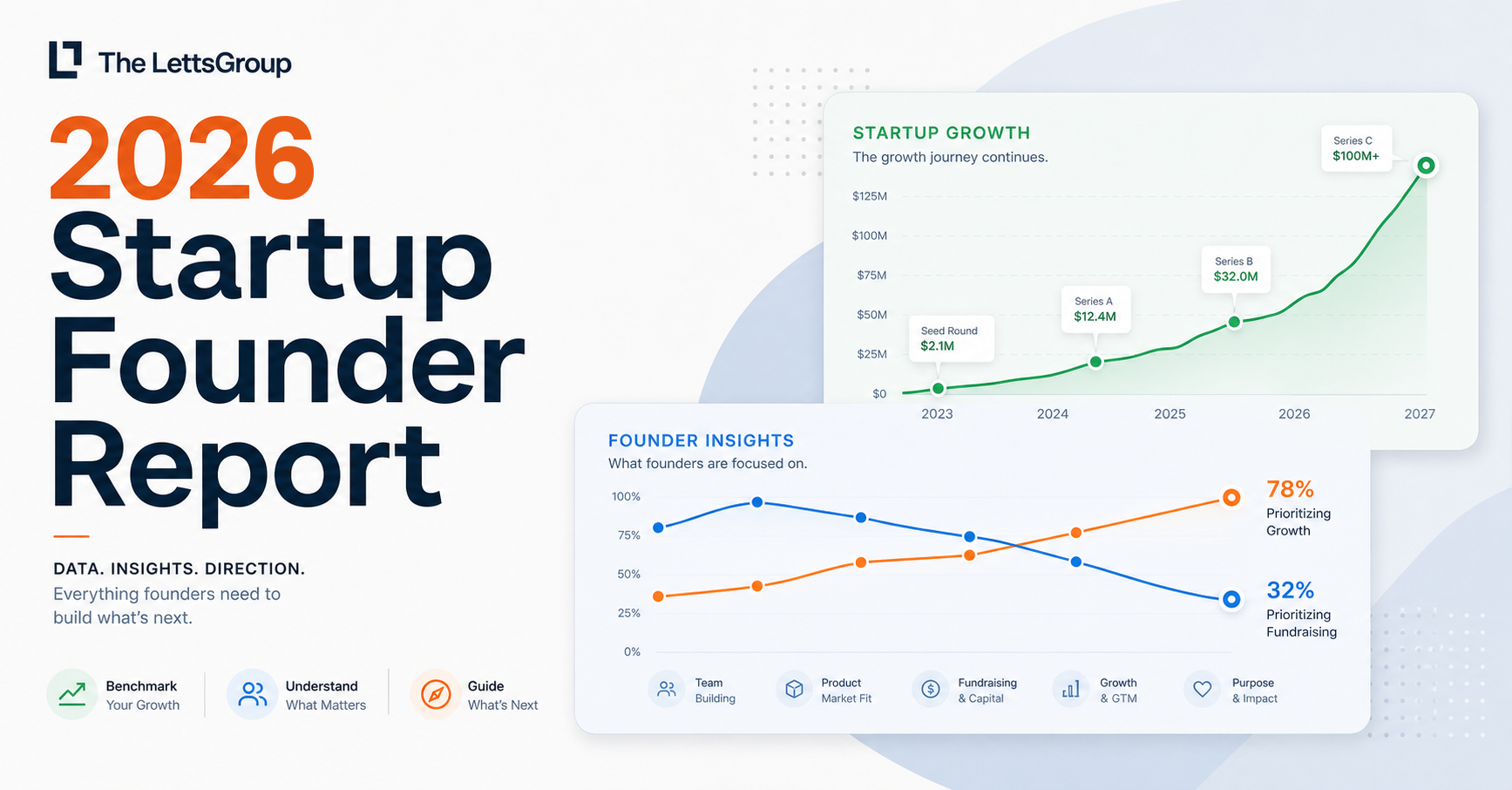
A year goes fast when you are building a startup. It goes faster when you are helping hundreds of founders do it at the same time. At LettsGroup, our VentureFactory platform and the Innov@te™ framework have been used by hundreds of first and second-time founders across the UK and North America in the past twelve months. We have seen what works, what fails, and what surprises founders when they look back.
This is our honest account of what we learned. We've laid out the patterns worth knowing before you build.
What Is the LettsGroup 2026 Startup Founder Report?
The LettsGroup 2026 Startup Founder Report is an annual reflection drawing on data, founder interviews, and platform usage patterns from hundreds of early-stage startups supported by LettsGroup's VentureFactory platform. It identifies the decisions and behaviours that separated founders who gained traction from those who did not. We covered the areas across validation, fundraising, product, and growth.
We didn't want to do a survey for opinions of our users but we did a pattern analysis of what actually happened. We wanted to understand the decisions made, the experiments run, the pivots taken, and the outcomes that followed.
The 10 Lessons That Mattered Most in 2026
1. Founders who validated early raised faster
Founders who completed structured problem and customer validation before building their MVP raised their first round an average of 11 weeks faster than those who did not. It led to our conclusion that investors are not buying your product. They are buying your evidence.
2. The build trap is still the number-one failure mode
The most common mistake first-time startup founders make is building before validating. More than 60% of founders who struggled to gain traction had spent significant time and money on product development before speaking to ten paying customers. It confirmed our premise that validation is not optional. It is the work.
3. AI tools accelerated speed-to-market — but only when used with structure
Founders who used AI tools without a framework reported confusion, inconsistent outputs, and wasted sprints. Founders who applied AI tools within a structured methodology, like the Innov@te™ framework, moved from idea to first revenue 40% faster on average. We found that the structure is the multiplier.
4. Pricing was under-tested almost universally
Less than 20% of founders ran a structured pricing experiment before launch. Most guessed. The founders who tested pricing (even with a simple survey and a fake door test ) landed on prices 30–50% higher than their initial assumption. It suggested that for most our first instinct on price is almost always too low.
5. The cap table surprised nearly everyone at Series A
First-time founders consistently underestimated how earlier dilution decisions accumulated. SAFEs and convertible notes signed in a hurry, at generous caps for investors, left some founders with less than 40% at Series A before taking the round. Model the conversion maths before you sign.
6. Community was the highest-ROI growth channel for pre-revenue founders
For founders without a marketing budget, founder communities both online and in-person generated more qualified leads than paid channels, content, or cold outbound. This was not surprising in isolation. What was surprising: fewer than 30% of founders had a systematic approach to community engagement. It needs to be something that the founder works on from the start and always because showing up occasionally is not a strategy.
7. Founders who hired too early struggled. Founders who used AI Co-Founders moved faster.
The pattern was consistent: early hires before product-market fit stretched runway and introduced coordination overhead. Founders who leaned on AI-native tools including VentureFactory's AI Co-Founders for finance, legal, content, and growth work kept their burn low and their velocity high. If you are building your first or second startup and you want the same leverage without the headcount cost, VentureFactory gives you an AI co-founding team from day one start free at letts.group
8. Fundraising took longer than expected but founders who prepared were fine
The median time from first investor conversation to first term sheet was 14 weeks for UK founders and 11 weeks for North American founders in 2026. Founders who were surprised by this timeline ran out of runway preparing. Founders who expected it and prepared their materials early pitch deck, data room, KPI dashboard were ready when the moment came.
9. Retention data was ignored until it was urgent
The founders who built retention tracking into their product from week one were the ones who caught churn signals early enough to fix them. Founders who waited until they noticed a problem had already lost customers they could have saved. Retention is a leading indicator, not a lagging one. Track it from day one.
10. The founders who shared their journey publicly grew faster
Building in public: sharing milestones, setbacks, and learnings on LinkedIn, X, and in founder communities consistently generated inbound interest, investor introductions, and early customers. It felt counterintuitive to many founders but it worked for nearly all who tried it.
What the Data Tells Us About 2026 and Beyond
AI-native startups that used structured venture-building frameworks such as the Innov@te™ framework from LettsGroup's VentureFactory moved from idea to first revenue 40% faster on average than those using ad-hoc approaches. The discipline of a framework compounds: each stage builds on a verified foundation rather than an assumption. The headline finding from this year is not that AI changed everything it is that structure still wins. The founders who moved fastest were not the ones with the best tools. They were the ones who applied tools methodically, validated before building, and stayed close to their customers throughout.
That is not new knowledge. But it is still rare behaviour. And that gap between what founders know and what they do is exactly the space VentureFactory is built to close.
Our Vision for 2027
We are building toward a world where any first or second-time founder regardless of background, network, or funding can build a structured, scalable, investor-ready startup with the same rigour as a top-tier accelerator cohort.We have a long way to go. But hundreds of founders in is not nothing. If you are at the start of your journey or mid-way through and feeling stuck, we built VentureFactory for exactly that moment. It is not a course, a community, or a tool. It is the platform that builds your startup with you, from idea to exit.
If you are starting your next venture or your first begin at letts.group