What Is Product-Market Fit — and How Do You Actually Know When You Have It?
6 October 2026
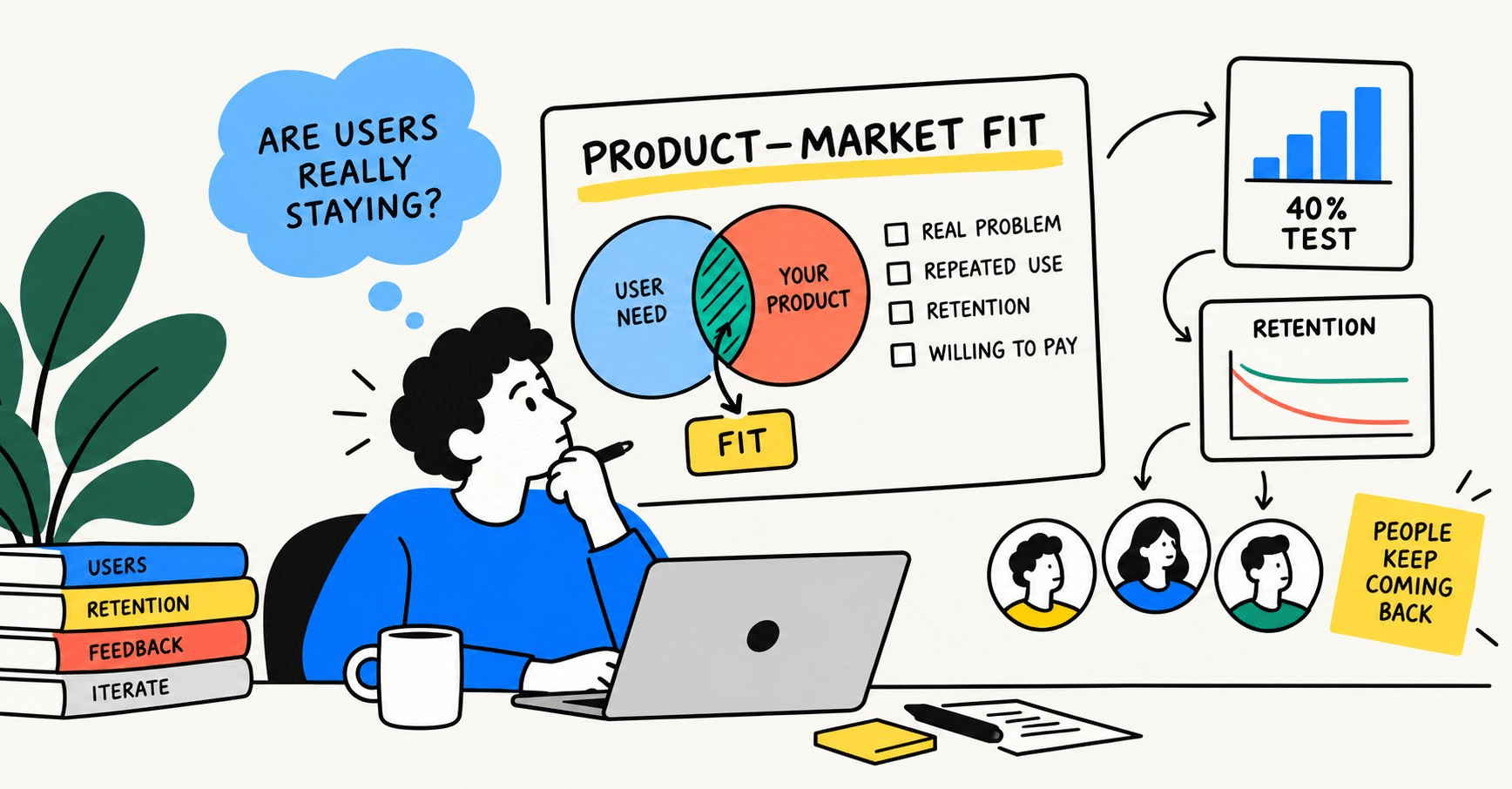
Product-market fit is one of the most used phrases in the startup world and one of the least precisely defined. Ask five experienced founders what it means and you will get five different answers, most of which are correct in some partial sense. The definitional looseness matters, because it creates a specific problem: founders often declare it prematurely, on the basis of signals that feel meaningful but do not actually tell them what they think they tell them.
The most cited benchmark comes from Sean Ellis, who worked in growth at Dropbox and Eventbrite and later published the question that became a standard early-stage diagnostic: if this product disappeared tomorrow, how disappointed would you be? Ellis found that companies with strong retention tended to cluster around a threshold where at least 40 percent of users said they would be "very disappointed." Below that threshold, the product could be improved and marketed harder, but the underlying fit was not yet there.
Think you’ve found product-market fit? Test the assumption before you scale it. VentureFactory helps you build the evidence behind the decisions that matter. Start free.
That benchmark has been widely used, not least because Superhuman's Rahul Vohra popularised it as the basis for Superhuman's early growth strategy. Its limitation is also well understood: it is a self-reported sentiment measure, which means it is useful but not conclusive. A user who would be very disappointed to lose your product might also find a tolerable substitute within a week. What the 40 percent rule gives you is a directional signal, not a certificate.
What the numbers actually measure
The more reliable indicator of product-market fit is retention behaviour rather than stated preference. A product people genuinely need tends to produce a retention curve that flattens rather than continuing to decline. In practical terms: if you cohort your users by the month they signed up and track what percentage of each cohort is still active at month three, month six and month twelve, a flattening curve (however modest the absolute level) is evidence that some users have genuinely incorporated the product into how they work. A curve that keeps declining suggests the product is interesting enough to try but not compelling enough to keep.
This is harder to measure at very early stages, when cohort sizes are too small to draw reliable conclusions. The substitute is a more careful form of qualitative research: not "would you be disappointed if this disappeared" but "tell me about the last three times you used this product and what you were doing instead of using it before." The thing worth understanding is the depth of integration. Specifically, whether the product has genuinely replaced a previous behaviour rather than simply been added on top of existing ones.

The mistake founders make most often
Declaring product-market fit on the basis of early enthusiasm is the most common version of this error. Early adopters are not representative customers. They have a higher tolerance for rough edges, are often intrinsically motivated to try new things, and have in many cases been personally recruited by the founder. The fact that twenty people you spoke to love the product is not the same finding as the fact that twenty people who found the product independently love it enough to still be using it six months later.
A related mistake is conflating growth with fit. A product can acquire users quickly through marketing spend or a viral moment while still failing the retention test. The question worth asking is whether users are staying because the product is genuinely useful to them or because they signed up recently and have not yet decided it is not.
A more useful framing
Product-market fit is better thought of as a threshold you cross than a state you enter. The crossing is visible in retrospect before it is visible in real time: founders typically describe it as a shift in the quality of inbound interest, a change in how users talk about the product, and a retention curve that finally behaves differently from what came before. Marc Andreessen's original description of the moment "when the product just seems to take on a life of its own" has the frustrating quality of being accurate and unactionable at the same time.
What you can do in the meantime is be precise about what you are measuring and why. Define your retention metric before you run the cohort analysis. Set a threshold for the 40 percent question before you survey users, rather than deciding afterwards whether the number you got was good enough. Run the qualitative interviews with people who found you independently, not people you personally signed up. The goal is to reach the honest conclusion earlier, when the cost of a pivot is still manageable.
Product-market fit is too important to declare because the numbers feel encouraging. The point of tracking the evidence inside Innov@te is not to produce a more sophisticated label for intuition, but to make it harder to mistake enthusiasm for proof. You may not know the precise moment you achieve product-market fit. You should at least know what evidence would convince you that you haven't.
Turn assumptions into evidence before they become expensive. Test and build your venture with the Innov@te Framework inside VentureFactory. Start free, no credit card required.