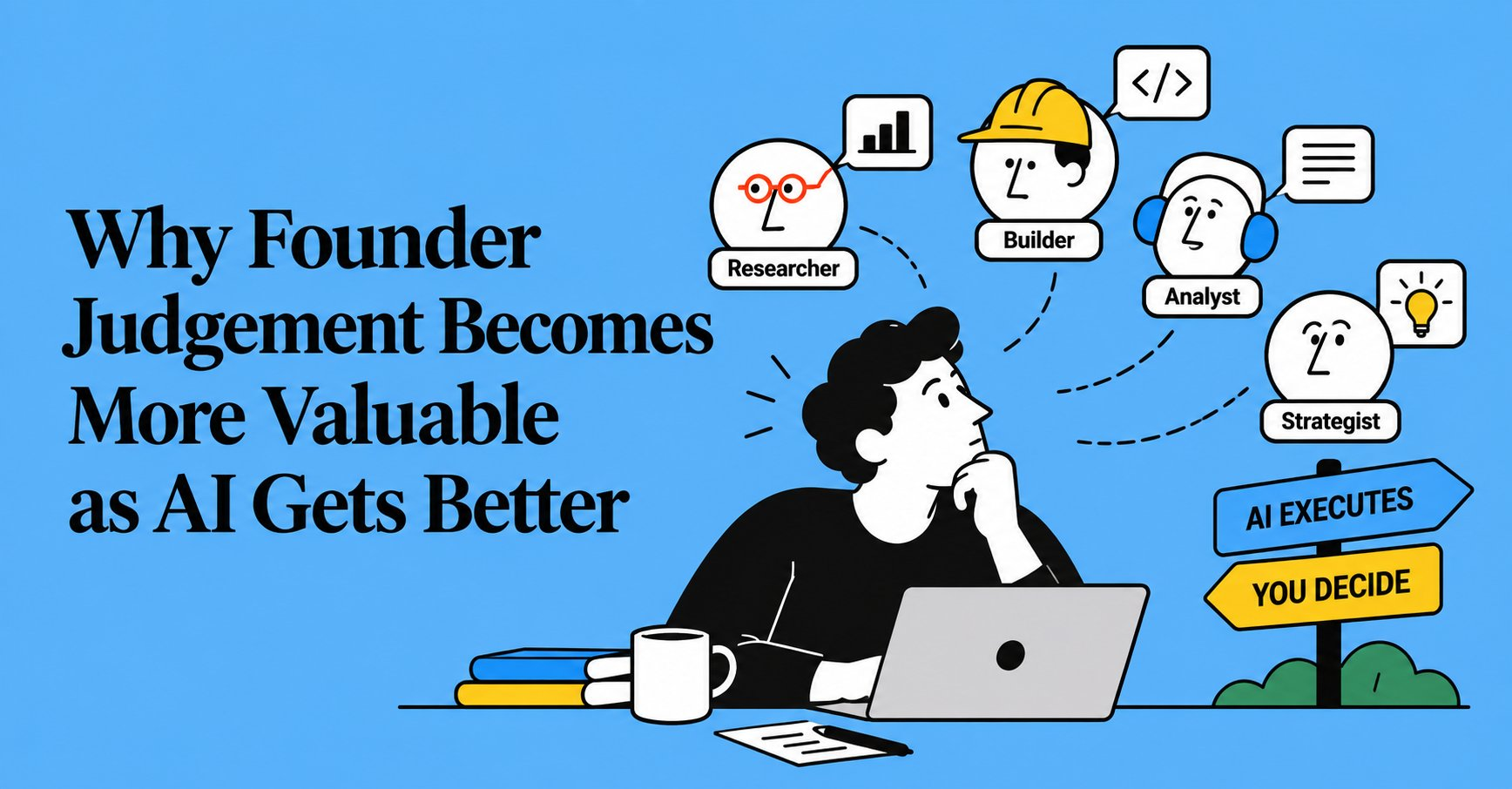
AI is making it remarkably cheap to act on an idea. A founder can research a market, produce a prototype, write a campaign or construct a financial model without assembling the sort of team that would once have been required. This is plainly useful. It also creates a slightly uncomfortable problem: AI has reduced the cost of executing a good decision without doing much to reduce the consequences of executing a bad one.
That changes the founder's job. When producing the work was expensive, execution itself consumed much of the company's attention. As execution becomes easier, deciding what deserves to be executed becomes more important. The scarce resource begins to move from capability towards judgement.
Judgement isn't intuition
Founder judgement can sound suspiciously like one of those qualities people acquire retrospectively after becoming successful. It is more practical than that. Judgement is making decisions when the information available is incomplete and the consequences of getting them wrong are uneven.
A founder constantly has to decide which evidence matters. One customer wants a feature immediately while another says it would ruin the product. An experiment performs badly, but it isn't obvious whether the proposition is wrong or the experiment was poorly designed. A market looks enormous on a research report and remarkably small once somebody actually tries to sell into it.
There is rarely enough information to make these decisions mechanically. The founder has to interpret what is happening, decide what deserves further investigation and occasionally conclude that the company has spent three months pursuing something that should now be abandoned.
AI can help enormously with that process. It can examine more information than a founder could reasonably read and expose patterns that might otherwise be missed. What it cannot conveniently remove is the founder's responsibility for deciding what those patterns mean for this particular company.
Build with AI without handing over the judgement. Try VentureFactory free.
AI can give you an answer to the wrong question
Imagine asking an AI system to recommend a pricing strategy. It can examine competitors, customer research and different financial scenarios. The output may be excellent. But somebody still chose the market being examined and decided which competitors were relevant. Somebody must decide whether the proposed price fits what the company has actually learned from customers.
The same problem appears in product development. AI can synthesise dozens of interviews and tell you which feature customers mentioned most frequently. That doesn't necessarily mean you should build it. Perhaps those customers are not the ones you ultimately want. Perhaps the feature is frequently requested precisely because every competitor already provides it. Frequency is information. It isn't automatically a decision.
Financial modelling makes the distinction particularly obvious. AI can produce increasingly sophisticated scenarios, but a beautiful model containing an implausible assumption remains an implausible model. The spreadsheet doesn't become more correct because it was produced in thirty seconds.
The important boundary, then, isn't between things humans can do and things machines can do. It sits between analysis and accountability. AI can increasingly participate in the analysis. The founder still owns what the company does next.
Faster execution makes bad judgement more dangerous
This is the part of the AI productivity story that receives less attention. A company that can execute much faster can also travel in the wrong direction much faster.
Suppose a founder incorrectly identifies the ideal customer. AI can now help produce the positioning, generate outreach and adapt the product around that assumption at extraordinary speed. The organisation may appear highly productive while becoming efficiently wrong.
That is why simply measuring the quantity of work AI allows a startup to produce isn't particularly useful. More campaigns aren't necessarily progress. Neither are more features or more elaborate strategy documents. The relevant question is whether the company is learning quickly enough to improve the decisions generating all that activity.
The founder therefore needs short feedback loops and enough intellectual flexibility to change course when the evidence changes. AI makes this easier in one sense because another iteration is cheap. It makes it harder in another because producing so much work can create the illusion that something important must be happening.
Keep the judgement. Accelerate the execution. Start building with VentureFactory free.
Keep judgement concentrated. Make execution abundant.
This distinction is one of the design principles behind VentureFactory. AI Co-Founders can do substantial work across a venture while the human founder retains responsibility for the consequential decisions. The purpose isn't to preserve human involvement for sentimental reasons. It is to put automation where its economic advantage is greatest without confusing faster execution with better judgement.
That boundary will undoubtedly move as AI improves. Founders will delegate decisions in the future that would seem reckless to delegate today. The interesting question isn't how much autonomy we can technically give AI. It is where human judgement continues to add enough value that surrendering it would make the company worse.
The paradox of increasingly capable AI may therefore be that it makes the founder more important in a narrower but more consequential role. When execution was scarce, much of entrepreneurship consisted of finding people capable of doing the work. When execution becomes abundant, somebody still has to decide which work is worth doing.
AI can make a startup extraordinarily efficient. The founder's job is to make sure it becomes efficient at being right.