Your AI Tools Are Getting Smarter. Your Business Isn't.
Why shared context, not more software, is the real advantage of an AI-native company.
There is a version of AI adoption that looks impressively productive but is dangerously fragile. A founder has assembled an arsenal of excellent tools. One writes marketing copy, another conducts research, a third builds financial models. Others handle customer support, legal documents and investor presentations. Each performs its assigned task remarkably well. The founder is producing more work, faster and at lower cost than ever before.
There is just one problem. None of these tools knows what the others are doing.
The fundraising assistant is still working from a pricing model that changed three weeks ago. The research tool has never heard of the competitor that launched in August. The customer support assistant is answering questions for the customer profile the business originally targeted, rather than the one its first twenty customers revealed.
Every tool is competent. Collectively, they are running several different versions of the same company.
The missing ingredient is not intelligence. It is shared context.
The problem isn't where you store information
The obvious response is better documentation. Build a knowledge base, organise the files, connect the applications and make sure everyone has access to the latest information. This helps, but it mistakes the symptom for the disease.
A company's knowledge is more than a collection of facts. It includes the assumptions that have been tested, the decisions that have been made, the evidence that changed those decisions and the questions that remain unresolved. A financial forecast is meaningless without knowing which assumptions underpin it. A customer profile is misleading if nobody knows why it changed. A strategy document can be perfectly accurate when written and dangerously wrong six months later.
Human teams encounter this problem constantly. Sales is pursuing customers the product team has stopped targeting. Finance is forecasting revenue from a pricing model marketing abandoned last quarter. Everyone is working hard, and the company is somehow moving in three directions at once.
Give each department an AI assistant and you can reproduce the same confusion at industrial speed.
AI doesn't eliminate organisational dysfunction. Without shared context, it automates it.
A shared brain, not another filing cabinet
What an AI-native business needs is not another place to store documents. It needs a system that maintains a coherent understanding of the company as it changes.
That means knowing what the business has learned, which assumptions remain valid, where the evidence came from and how one decision affects another. When the pricing model changes, that should matter to the fundraising strategy. When customers reveal a different use case, that should influence product development, marketing and financial projections.
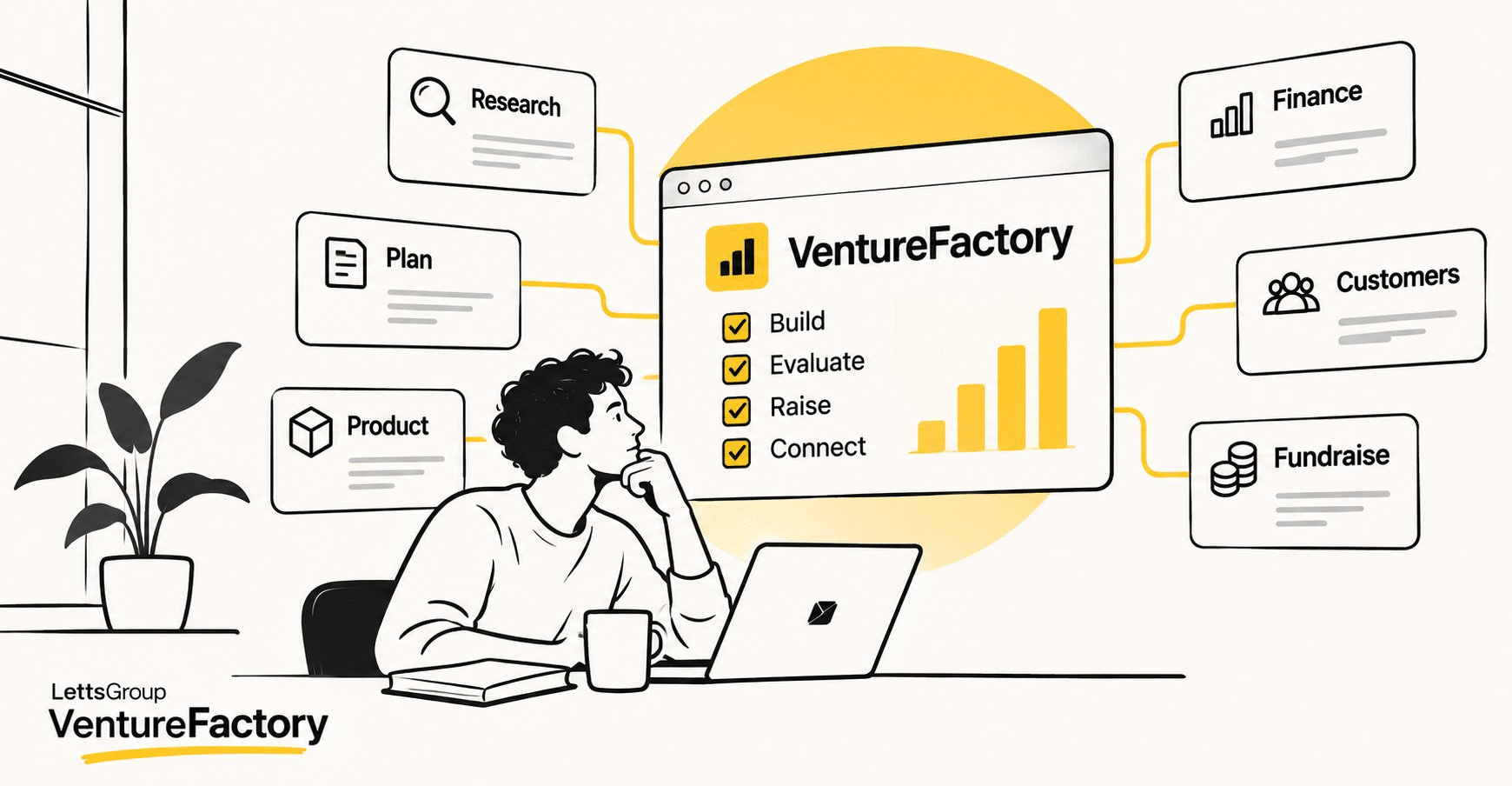
This is the design principle behind LettsGroup's VentureFactory.
Your AI tools should share more than a login. VentureFactory connects your business knowledge, evidence and decisions so its AI Co-Founders work from the same understanding. Start free.
Its Venture Data Room provides a shared foundation of venture information and evidence. The seven-stage Innov@te™ Framework structures what founders need to establish as their businesses develop, while specialist AI Co-Founders work from a common understanding rather than a collection of disconnected conversations.
VentureFactory also introduces an important discipline through Venture Eval, which reviews the venture's work for accuracy, relevance, evidence traceability and internal consistency. It helps expose the contradictions that can emerge when different parts of a business evolve at different speeds.
The objective is not simply to generate better documents. It is to make the work of building a company more coherent.
Stop making your AI tools work from different versions of your business. Explore how VentureFactory connects your venture's knowledge, decisions and execution. Start free.
The founder still makes the decisions
There is a temptation to describe this as an autonomous company, with AI agents making decisions while the founder watches from a comfortable distance. It is an attractive fantasy, particularly to anyone who has spent a Friday evening reconciling three contradictory spreadsheets.
But the point of shared intelligence is not to remove human judgement. It is to improve the information on which that judgement depends.
AI can identify inconsistencies, retrieve evidence, challenge assumptions and execute work. It cannot take responsibility for the consequences of a founder's decisions. Nor should it quietly turn an untested assumption into company policy simply because the same claim appears in five documents.
A founder who knows what the business has actually learned is in a stronger position than one relying on memory, intuition and whichever AI conversation happens to be open.
The advantage is not that the machine runs the company. It is that the founder no longer has to carry the entire company around in their head.
The advantage that compounds
The most interesting consequence of shared context emerges over time.
Consider two startups using equally capable AI models. Both can generate research, develop plans and produce financial forecasts. Both have access to essentially the same technology. After twelve months, however, one has accumulated a connected record of its experiments, customer feedback, strategic decisions, mistakes and revisions. The other has accumulated hundreds of documents and chat histories scattered across half a dozen applications.
The first company can build on what it has learned. The second must keep reconstructing its own history.
This is the distinction between productivity and institutional intelligence. Productivity measures how much work gets done. Institutional intelligence determines how much of that work continues to be useful.
Most AI adoption strategies focus almost entirely on the first. They promise faster outputs, lower costs and fewer people required to complete familiar tasks. Those benefits are real, but they are increasingly available to everyone. Access to a powerful AI model is unlikely to remain a durable competitive advantage when your competitors can use the same model tomorrow.
A company's accumulated knowledge is different. The evidence it has gathered, the mistakes it has made and the decisions it has tested against reality are specific to that business. When those lessons remain connected and usable, their value can grow with every subsequent decision.
The competitive advantage isn't how much AI your company uses. It's how much your company remembers, understands and learns.
The next generation of successful AI-native businesses will not necessarily be the ones with the most tools. They will be the ones whose tools work from the same understanding of the business, and whose founders can turn accumulated knowledge into better decisions.
Build a business that gets smarter as it grows. VentureFactory combines specialist AI Co-Founders, the Innov@te Framework, a shared Venture Data Room and Venture Eval to help founders build with greater consistency and confidence.
Stop building a collection of AI outputs. Start building a business that learns. VentureFactory combines shared intelligence, the Innov@te Framework and Venture Eval to help your company grow smarter with every decision. Start free, no credit card required.