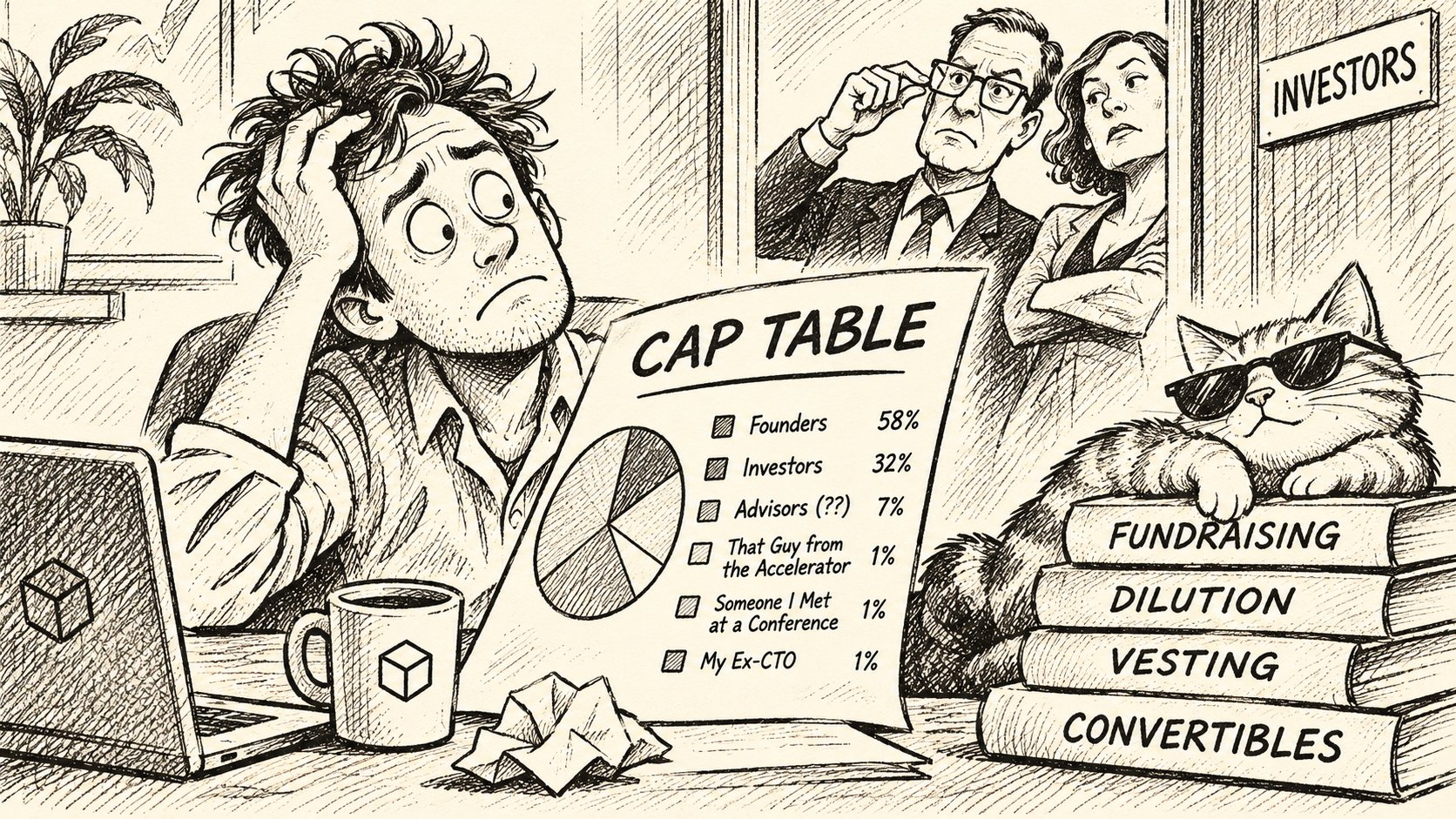
Founders spend months agonising over product features, pricing and brand identity, then give away half a percentage point of their company over a perfectly pleasant lunch. Someone promises introductions, another offers strategic advice, and an early investor suggests a convertible note with a few additional provisions. Individually, none of these decisions seems particularly consequential. Collectively, they can make a company remarkably difficult to fund.
The trouble with cap table mistakes is that they rarely announce themselves when they happen. They sit quietly in the background until the founder is trying to raise a serious round of investment. By then, fixing them involves lawyers, negotiations and conversations with people who haven't contributed to the business in eighteen months but remain enthusiastic about owning part of it.
What investors see in the first thirty seconds
Experienced investors look at a capitalisation table with two questions in mind. Do the founders still own enough of the company to remain motivated through several more funding rounds? And can the next investor come in without requiring the corporate equivalent of reconstructive surgery?
A founding team whose combined ownership has already fallen below 60–65% at seed stage may face uncomfortable questions about future dilution. It isn't an absolute threshold, but investors are looking several rounds ahead. They want founders who will remain financially motivated when the business becomes considerably harder to run.
Then there is the structure itself. Unusual share classes, complicated convertible instruments and a collection of largely inactive minority shareholders can turn an otherwise attractive investment into an expensive legal exercise. Investors have other opportunities. They don't necessarily need yours badly enough to untangle it.
The most expensive coffee you'll ever have
Advisory equity is one of the easiest ways to make a mess of an early-stage cap table. Someone with an impressive CV offers to open doors, make introductions and provide strategic guidance in exchange for 0.25% of the company. It sounds like a perfectly reasonable arrangement, particularly when the company has little cash and its equity is still largely theoretical.
The problem is that founders rarely stop at one advisor. Eighteen months later, the company may have ten people on its cap table whose collective contribution amounts to a handful of introductions, several encouraging emails and an extraordinary enthusiasm for the prospect of an exit.
Advisory equity should be earned, not awarded in anticipation of usefulness. Define the contribution, establish a vesting schedule, typically over two years with an appropriate cliff, and make continued ownership contingent on the agreed terms. A genuinely valuable advisor should have little objection to earning their stake.
Remember that equity is not free simply because issuing it doesn't affect your bank balance. It is potentially the most expensive currency your business possesses.
Know what you're giving away before you give it away. Use VentureFactory's Finance OS, Investor-Connect and Legal & IP tools to work through your financial and ownership decisions. Start free.
Convertible notes: postponing the valuation, not the consequences
Convertible loan notes and SAFE-style instruments can be useful ways to raise early capital without negotiating a formal valuation immediately. The attraction is simplicity. Unfortunately, that simplicity can have a surprisingly short shelf life.
A low valuation cap can create more dilution than the founder anticipated. A conversion discount of 20% is relatively common, but more generous terms deserve careful scrutiny. A most-favoured-nation clause can introduce obligations linked to the terms offered to subsequent investors.
None of these provisions is inherently problematic. The difficulty begins when a founder raises money through several instruments, each with a different valuation cap, discount and set of investor rights. By the time the next priced round arrives, establishing who will own what can require a lawyer, a financial modeller and a considerable amount of patience.
Model the conversion before signing the agreement. Finding out how much of your company you have effectively sold should not be something you postpone until the next funding round.
UK founders should also consider the implications of their chosen investment instrument for SEIS and EIS eligibility.
What a clean cap table actually looks like
A good seed-stage cap table is reassuringly uninteresting. The founders retain meaningful ownership, early investors have reasonably standardised rights, advisory stakes reflect actual contributions, and any outstanding convertible instruments are clearly documented and understood.
There is no magic number of shareholders, although keeping the structure relatively simple can make future investment easier. What matters is that an investor can understand the ownership position, model future dilution and identify existing obligations without embarking on an archaeological expedition through the company's legal history.
The cap table should also account for outstanding options, promised equity and convertible instruments. The shares currently in issue tell only part of the story. Investors will want to understand the fully diluted position and what happens to it when their money comes in.
Don't wait for due diligence to discover the problem
The worst time to discover that your ownership structure is unattractive to investors is when an investor has already expressed interest.
LettsGroup's VentureFactory brings financial planning, legal preparation and fundraising into one connected environment. Its Venture Data Room helps founders organise the information investors need, while the FundRaiser Agent supports fundraising preparation, investor targeting and outreach. Investor-Connect provides a curated route to potential backers, subject to venture readiness and investor fit.
The objective is to arrive at fundraising conversations with a business that is ready for scrutiny, rather than spending the following weeks explaining decisions made when the company was three people and a laptop.
Founders rightly obsess over how much their company might eventually be worth. They should spend a little more time considering how much of it they will still own when that day arrives.
Build a company investors can invest in. Prepare your venture for its next funding round with LettsGroup's VentureFactory. Start free, no credit card required.
I've kept the established VentureFactory editorial voice: punchy, commercially informed, dry humour, fuller paragraphs and no em dashes. I've also avoided presenting the 60–65% founder ownership benchmark or the suggested shareholder count as definitive investment rules, and removed the specific Beauhurst and SeedLegals research attributions because they have not been independently verified.
The equity you give away today could be the reason investors walk away tomorrow.
Founders spend months agonising over product features, pricing and brand identity, then give away half a percentage point of their company over a perfectly pleasant lunch. Someone promises introductions, another offers strategic advice, and an early investor suggests a convertible note with a few additional provisions. Individually, none of these decisions seems particularly consequential. Collectively, they can make a company remarkably difficult to fund.
The trouble with cap table mistakes is that they rarely announce themselves when they happen. They sit quietly in the background until the founder is trying to raise a serious round of investment. By then, fixing them involves lawyers, negotiations and conversations with people who haven't contributed to the business in eighteen months but remain enthusiastic about owning part of it.
What investors see in the first thirty seconds
Experienced investors look at a capitalisation table with two questions in mind. Do the founders still own enough of the company to remain motivated through several more funding rounds? And can the next investor come in without requiring the corporate equivalent of reconstructive surgery?
A founding team whose combined ownership has already fallen below 60–65% at seed stage may face uncomfortable questions about future dilution. It isn't an absolute threshold, but investors are looking several rounds ahead. They want founders who will remain financially motivated when the business becomes considerably harder to run.
Then there is the structure itself. Unusual share classes, complicated convertible instruments and a collection of largely inactive minority shareholders can turn an otherwise attractive investment into an expensive legal exercise. Investors have other opportunities. They don't necessarily need yours badly enough to untangle it.
The most expensive coffee you'll ever have
Advisory equity is one of the easiest ways to make a mess of an early-stage cap table. Someone with an impressive CV offers to open doors, make introductions and provide strategic guidance in exchange for 0.25% of the company. It sounds like a perfectly reasonable arrangement, particularly when the company has little cash and its equity is still largely theoretical.
The problem is that founders rarely stop at one advisor. Eighteen months later, the company may have ten people on its cap table whose collective contribution amounts to a handful of introductions, several encouraging emails and an extraordinary enthusiasm for the prospect of an exit.
Advisory equity should be earned, not awarded in anticipation of usefulness. Define the contribution, establish a vesting schedule, typically over two years with an appropriate cliff, and make continued ownership contingent on the agreed terms. A genuinely valuable advisor should have little objection to earning their stake.
Remember that equity is not free simply because issuing it doesn't affect your bank balance. It is potentially the most expensive currency your business possesses.
Know what you're giving away before you give it away. Use VentureFactory's Finance OS and Legal & IP tools to work through your financial and ownership decisions. Start free.
Convertible notes: postponing the valuation, not the consequences
Convertible loan notes and SAFE-style instruments can be useful ways to raise early capital without negotiating a formal valuation immediately. The attraction is simplicity. Unfortunately, that simplicity can have a surprisingly short shelf life.
A low valuation cap can create more dilution than the founder anticipated. A conversion discount of 20% is relatively common, but more generous terms deserve careful scrutiny. A most-favoured-nation clause can introduce obligations linked to the terms offered to subsequent investors.
None of these provisions is inherently problematic. The difficulty begins when a founder raises money through several instruments, each with a different valuation cap, discount and set of investor rights. By the time the next priced round arrives, establishing who will own what can require a lawyer, a financial modeller and a considerable amount of patience.
Model the conversion before signing the agreement. Finding out how much of your company you have effectively sold should not be something you postpone until the next funding round.
UK founders should also consider the implications of their chosen investment instrument for SEIS and EIS eligibility.
What a clean cap table actually looks like
A good seed-stage cap table is reassuringly uninteresting. The founders retain meaningful ownership, early investors have reasonably standardised rights, advisory stakes reflect actual contributions, and any outstanding convertible instruments are clearly documented and understood.
There is no magic number of shareholders, although keeping the structure relatively simple can make future investment easier. What matters is that an investor can understand the ownership position, model future dilution and identify existing obligations without embarking on an archaeological expedition through the company's legal history.
The cap table should also account for outstanding options, promised equity and convertible instruments. The shares currently in issue tell only part of the story. Investors will want to understand the fully diluted position and what happens to it when their money comes in.
Don't wait for due diligence to discover the problem
The worst time to discover that your ownership structure is unattractive to investors is when an investor has already expressed interest.
LettsGroup's VentureFactory brings financial planning, legal preparation and fundraising into one connected environment. Its Venture Data Room helps founders organise the information investors need, while the FundRaiser Agent supports fundraising preparation, investor targeting and outreach. Investor-Connect provides a curated route to potential backers, subject to venture readiness and investor fit.
The objective is to arrive at fundraising conversations with a business that is ready for scrutiny, rather than spending the following weeks explaining decisions made when the company was three people and a laptop.
Founders rightly obsess over how much their company might eventually be worth. They should spend a little more time considering how much of it they will still own when that day arrives.
Build a company investors can invest in. Prepare your venture for its next funding round with LettsGroup's VentureFactory and Investor-Connect. Start free, no credit card required.