The SaaS industry loves a benchmark. Unfortunately, your customers haven't read it.
Customer acquisition cost (CAC) is one of the first metrics startup founders learn and one of the first they misuse. Divide what you spend acquiring customers by the number you acquire, and you have a number that looks reassuringly precise. Put it in a spreadsheet, compare it with an industry benchmark and announce that your acquisition strategy is either brilliant or disastrous. Unfortunately, the calculation is considerably more reliable than the conclusion.
Ask what constitutes a good CAC for an early-stage SaaS business and the only sensible response is another question. What are you selling, how long do customers stay, and where did they come from? A £200 acquisition cost might be ruinous for a £10 monthly subscription and excellent for a £500 one. Without context, CAC tells you how much you spent, not whether it was money well spent.
The 3:1 rule is useful. Until it isn't.
The conventional SaaS wisdom is that customer lifetime value (LTV) should be at least three times customer acquisition cost. Spend £100 acquiring a customer, generate £300 in lifetime value, and the economics begin to look promising. The 3:1 LTV ratio is a useful benchmark for an established SaaS business. For a pre-seed startup, however, it can be a triumph of arithmetic over evidence.
Lifetime value depends on retention, churn, gross margin and sometimes expansion revenue. A founder with six months of customer history cannot know what a typical customer will be worth over three years. They can estimate it, but an estimate with two decimal places remains an estimate.
This doesn't make LTV worthless. It makes it a destination rather than a starting line. At an early stage, the more revealing question is whether acquisition is becoming cheaper as the company learns, and whether customers are staying long enough to justify the cost of finding them.
A business moving towards sustainable economics may be healthier than one reporting a beautiful ratio built on imaginary retention.
The benchmark trap
SaaS benchmarking research from firms such as OpenView, Bessemer and KeyBanc has helped establish CAC payback as another important measure. This is the time required to recover customer acquisition costs through the gross profit customers generate.
A payback period under twelve months is generally attractive. Twelve to eighteen months can be workable, depending on the business model, growth rate and access to capital. Beyond twenty-four months, the demands on cash become much harder to ignore.
But benchmarks are not commandments. A company selling enterprise software with substantial contract values has different economics from a self-service SaaS product charging £19 a month. Comparing the two without accounting for their sales cycles, margins and retention is like judging a bicycle and a freight train by how quickly they reach thirty miles an hour.
The numbers are useful. The comparison may not be.
Your average CAC is hiding the interesting part
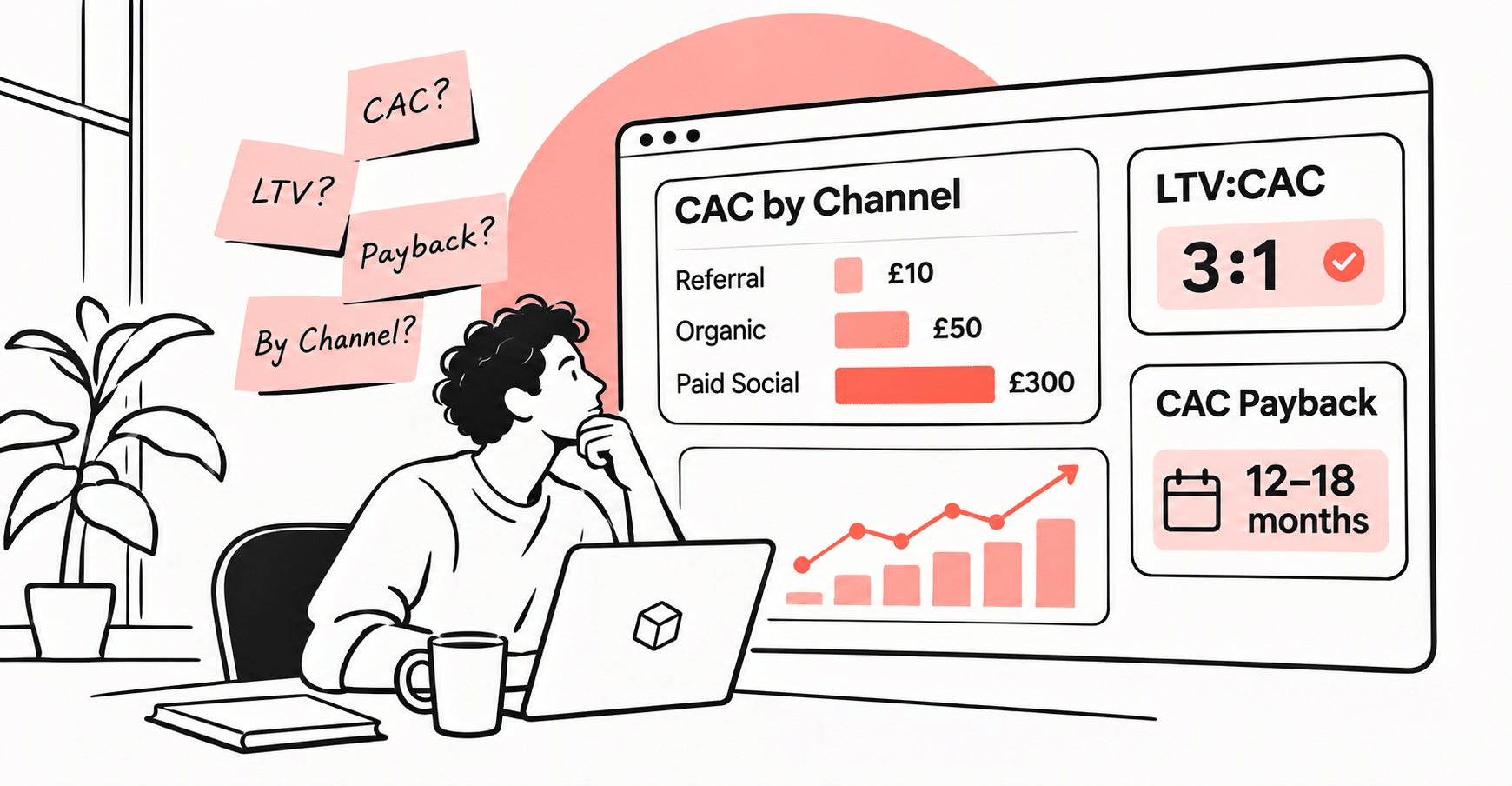
The most misleading CAC number in an early-stage business is often the one founders proudly put on their dashboard: blended CAC. Imagine you've acquired thirty customers. Ten came through paid advertising, ten through organic search and ten through referrals. Your average CAC is £120. What have you learned? Almost nothing about where to spend your next £1,000.
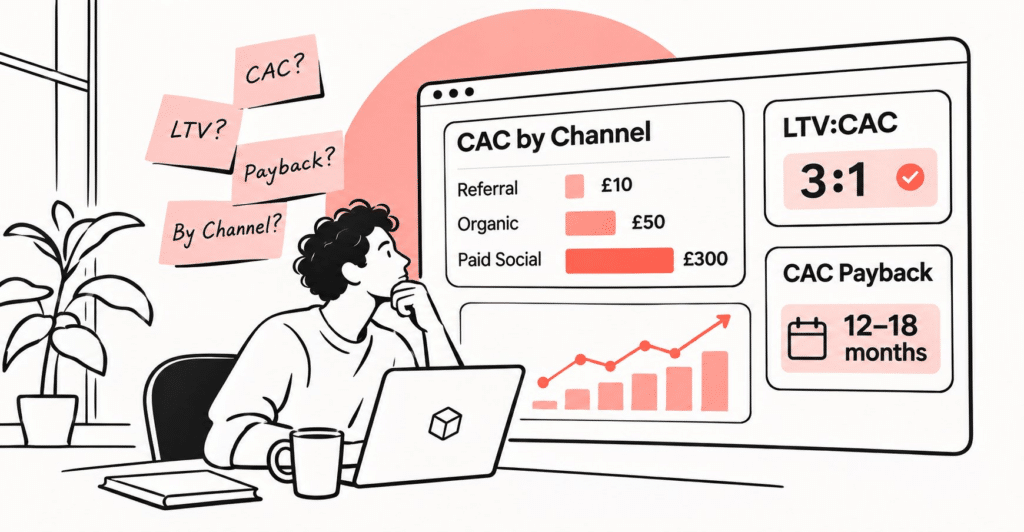
Perhaps paid advertising costs £300 per customer, organic search £50 and referrals £10. The average conceals a fifteenfold difference between the most and least expensive channels. Worse, those customers may behave differently after signing up. The expensive customers might churn quickly, while referred customers stay for years. Your blended CAC could remain unchanged even as your best acquisition channel deteriorates and your worst one consumes more of the budget.
Averages are excellent at concealing problems. That's why they are so popular in board presentations.
The useful question is not simply how much it costs to acquire a customer. It's which channels produce customers who stay, pay and eventually generate more value than they cost.
Stop guessing which marketing channels deserve your budget. VentureFactory's Growth Engine helps founders track campaign sources, acquisition performance and the customers those campaigns produce. Start free.
What should founders measure first?
At pre-seed, the answer is less complicated than the industry sometimes makes it sound. Track where every customer came from. Record what you spent to acquire them, including the relevant people and campaign costs. Watch how much gross profit those customers generate and how long it takes to recover the acquisition expense. As cohorts mature, compare retention and lifetime value by channel.
You don't need a sophisticated financial model to discover that referrals produce loyal customers while paid social produces expensive trial users who disappear after a fortnight. You do need enough discipline to record the difference. CAC payback by channel is a useful early indicator, although tiny cohorts and founder-led referrals can distort the picture. A referral channel that produces ten customers cheaply may not be capable of producing a thousand. Equally, a paid channel that performs poorly in its first month may improve with better targeting and creative.
The objective is to learn where acquisition becomes repeatable and profitable, not to declare a winner after the first twenty sign-ups.
Build the evidence before you build the forecast
The uncomfortable truth is that most early-stage startups don't have enough data to calculate a reliable lifetime value. That's perfectly normal. What matters is whether they are collecting the right information so that their decisions improve as the business grows.
VentureFactory's Growth Engine brings campaign tracking, lead sources and customer information into the wider venture-building process. Rather than reconstructing acquisition history from old spreadsheets when investors start asking questions, founders can build a consistent record from their earliest campaigns.
And that is ultimately what good unit economics require: evidence accumulated over time, not a benchmark copied into a pitch deck.
The goal isn't to achieve an impressive CAC. It's to discover a repeatable way to acquire customers profitably. Those are very different achievements, and only one builds a sustainable business.
Know where your customers come from and what they're worth. Use LettsGroup's VentureFactory to connect acquisition data with your growth strategy and financial planning. Start free, no credit card required.