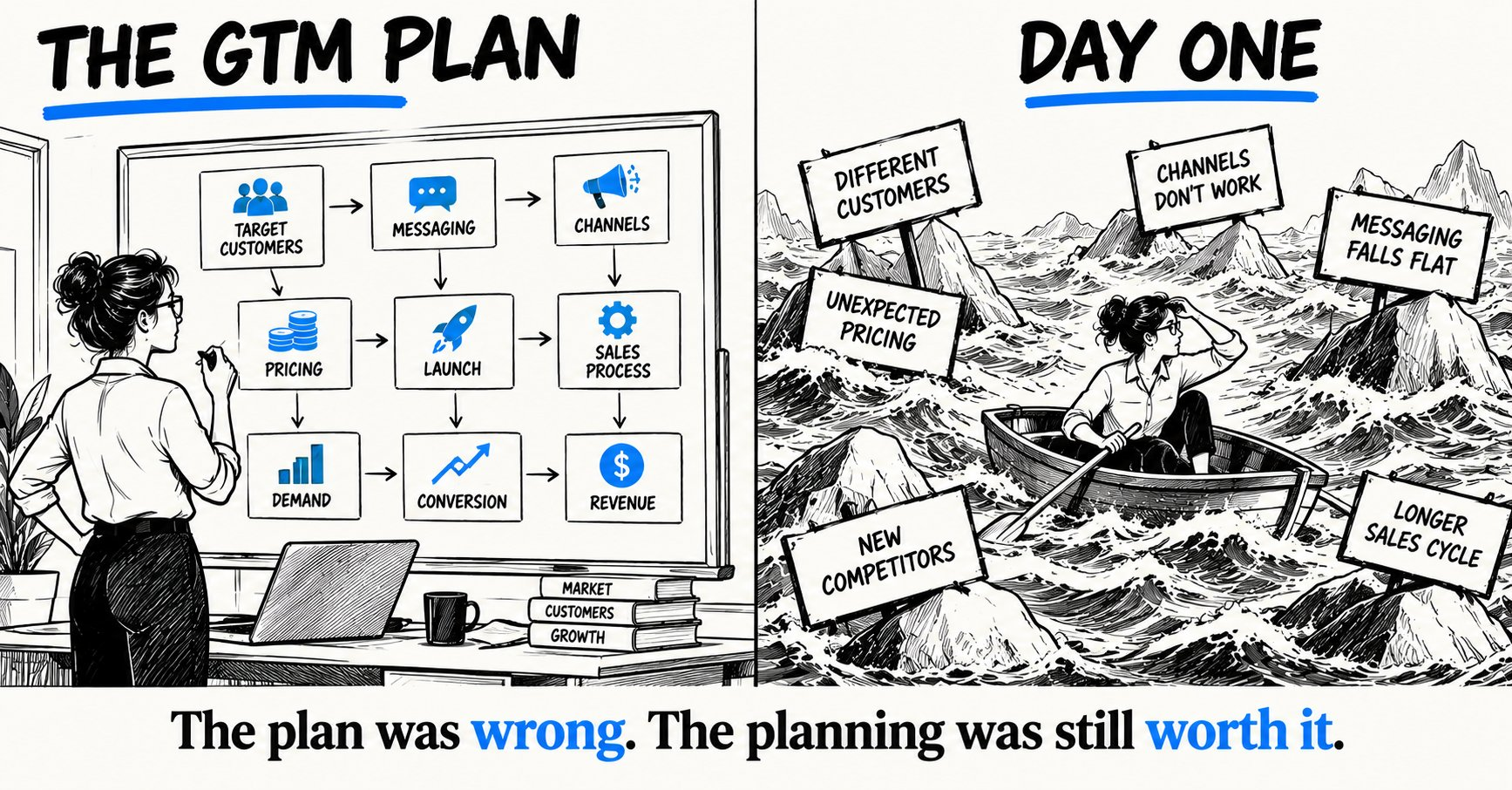
Every go-to-market plan is wrong. That's not a criticism of the founders who write them or the advisors who help. It's built into the exercise. A GTM plan rests on assumptions about which customers exist, how they behave, what they value and how they decide, and every one of them is made before the founder has systematic evidence. The plan is fiction. Well-reasoned fiction, but fiction.
So the useful question isn't whether the plan will survive contact with the market. It won't, not in its specifics. The useful question is what the plan is for, and whether founders treat it that way.
The two failure modes
There are two ways to fail at GTM planning, and they sit at opposite ends of the same mistake.
The first is over-planning. Months go into a comprehensive strategy, covering channel mix, messaging frameworks, ICP definitions, pricing tiers and competitive positioning, before a single customer has validated any of it. The plan becomes something to protect, not a hypothesis to test. When the market responds differently from the model, the instinct is to defend the plan instead of revising it.
Build a GTM plan you can test, not just present. VentureFactory helps you turn market assumptions into actionable experiments. Start free.
The second is the reverse: treating the market's first response as a reason to drop structured thinking altogether. "We'll just figure it out as we go" is the motto of companies that keep figuring it out until they run out of time. GTM by instinct occasionally works, usually for founders with strong existing relationships in exactly the right market. It fails often enough that it shouldn't be the default.
What the plan is actually for
A GTM plan's value isn't accuracy. It's the clarity it forces. Writing down which customers you'll approach, through which channels, with which message, at which price, forces decisions you'd otherwise put off. The real work is in the argument that comes before the writing. Which segment first? If someone pushes back, can you defend it? If not, why not?
A plan argued through properly, not necessarily long, just a set of considered positions, gives the team a shared starting point. When the first customer behaves differently from the model, the plan tells you which assumption was tested and what the result means. Without it, the same customer response is just noise.
The discipline of the living plan
The founders who handle GTM best treat the plan the way scientists treat a hypothesis: something to test, not something to confirm. Your first customer arrives through cold outreach instead of the inbound channel you prioritised? That's data. The customer who converts is from a different segment than your ICP? Data. The pricing conversation goes differently from the model? Data. None of these are failures of the plan. They're the plan working as intended.
Treating market feedback as an obstacle instead of an input is what makes go-to-market hard. Markets respond with the information they actually have, not the information founders wish they had. The plan that survives is the one designed to be revised, not the one designed to be right.
The Innov@te framework treats the GTM stage as a living set of validated assumptions, not a fixed document. Each channel, ICP definition and pricing decision is tracked against the evidence gathered for it. The plan doesn't disappear when the market responds. It gets updated. That's a small but meaningful difference from the GTM plan that gets filed and quietly ignored.
A note on timing
One kind of premature GTM planning deserves its own warning: the launch plan written before the product is validated. A detailed go-to-market strategy for a product that hasn't confirmed it solves a real problem is a plan for scaling a mistake. Sequence matters. Validate the problem, validate the solution, then plan the market entry. That order doesn't guarantee success. Any other order has a documented failure rate that's hard to argue with.
Your GTM plan should evolve as your market responds. Use the Innov@te Framework inside VentureFactory to test your strategy and adapt it as you learn. Start free, no credit card required.