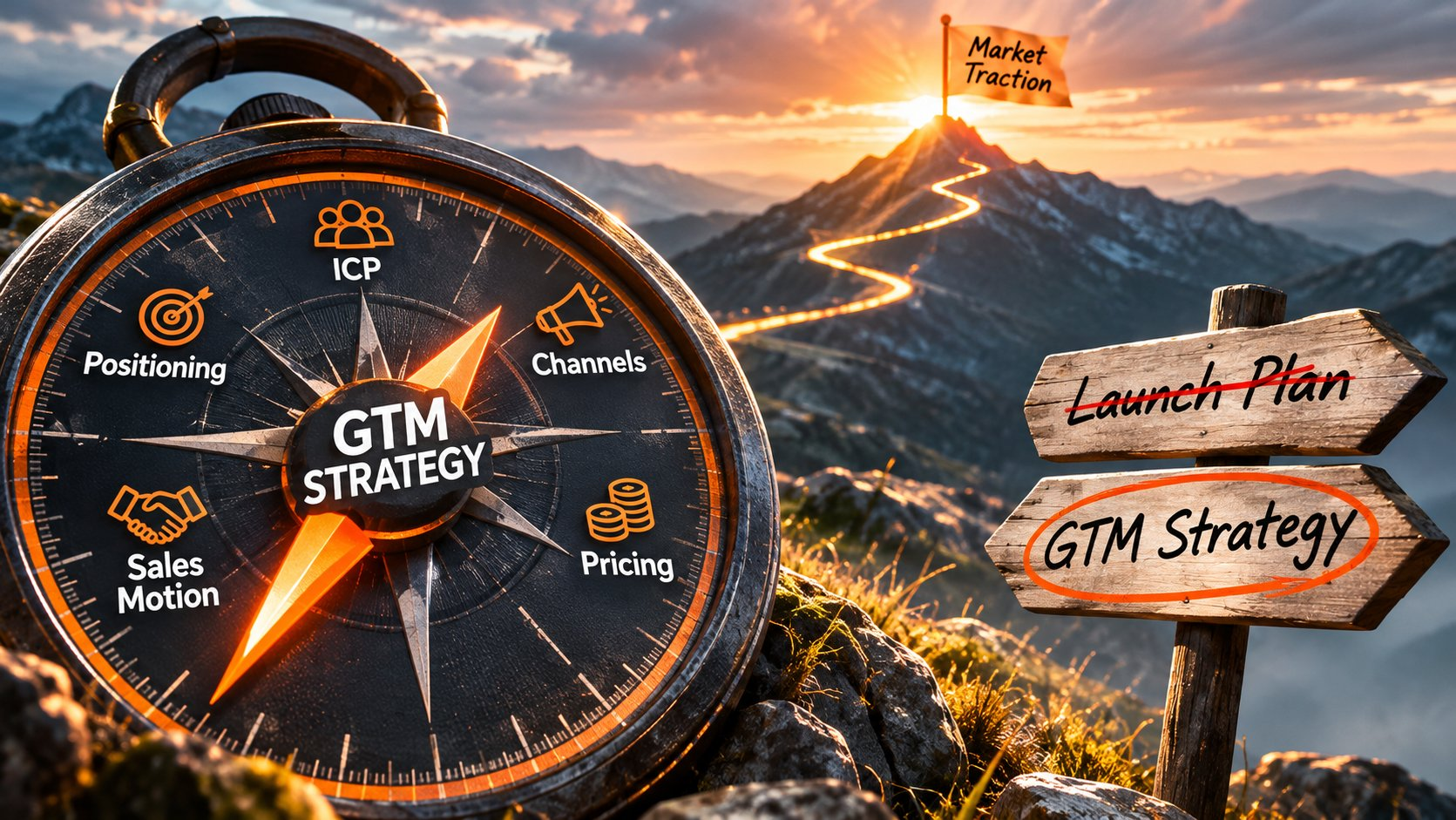
Why so many SaaS founders confuse launching a product with finding a market.
Most founders approach their product launch with an impressive amount of organisation. The website is ready, the social media calendar is populated, the press release is written and somebody has even remembered to set up the analytics. Everything is in place except a convincing reason why anyone should buy the product.
This is what happens when founders confuse a launch plan with a go-to-market (GTM) strategy. A launch plan tells you what happens on Monday. A GTM strategy tells you why any of it is worth doing.
The distinction becomes painfully apparent three months after launch, when the marketing budget is disappearing, customer acquisition is proving harder than expected and the founding team is debating questions it should have answered before spending anything.
If your customer is everyone, your customer is nobody
The ideal customer profile (ICP) is the foundation of every subsequent commercial decision. Your pricing, messaging, distribution channels and sales process depend on knowing precisely who you are trying to sell to. Yet founders routinely describe their target customer in terms so broad that they are practically meaningless.
"SaaS founders in the UK" is a market segment. A first-time SaaS founder with fewer than five employees, managing company operations manually and preparing for a first funding round, is a potential customer you can actually understand. You can make informed assumptions about their problems, their budget and what might persuade them to buy.
There is a wonderfully simple test for whether your ICP is sufficiently defined: can you name the first ten companies you would approach? If not, you probably haven't finished defining it.
Your favourite marketing channel may be your worst
Founders have a curious habit of confusing their personal preferences with commercial strategy. Those who enjoy writing decide content marketing is the answer. Those who enjoy being on camera discover the strategic importance of video. Former sales executives are remarkably fond of outbound.
The customer, inconveniently, may have other ideas.
Before investing in a marketing channel, run small experiments. A fortnight of targeted outreach to fifty prospects, a month of focused LinkedIn content or a modest paid advertising campaign can reveal more about customer behaviour than weeks spent developing a marketing strategy in isolation.
Compare conversion rates, acquisition costs and the quality of the prospects each channel produces. Give the most promising channel more attention and find out whether its performance is repeatable. Building an elaborate marketing operation before establishing whether the channel works is an expensive way of conducting an experiment.
Find your customers before you spend a fortune trying to reach them. VentureFactory's Innov@te Framework and Growth Engine help founders validate customer profiles, test channels and track the results. Start free.
Your pricing determines how you sell
Pricing is often treated as a financial decision, settled somewhere between building the product and launching it. But the price you charge has enormous implications for how you take that product to market.
A £49 monthly subscription generally needs a largely self-service acquisition process. At £500 a month, a sales conversation may be commercially viable. At £5,000 a month, you are increasingly likely to encounter procurement departments, multiple decision-makers and people whose principal contribution to the purchasing process is requesting another meeting.
Each price point creates a different commercial challenge. A business charging £49 a month cannot afford to spend several hours personally persuading every customer to subscribe. Equally, a company selling expensive enterprise software should not assume that a well-designed landing page will close the deal.
The price, the customer and the cost of selling must make sense together. Discovering that they don't after launch is particularly expensive.
Founders should sell before they hire salespeople
There is a good reason founder-led sales works for so many early-stage SaaS businesses. The founder is not merely selling the product. They are discovering why someone might want it, what prevents them from buying it and whether the problem the company thinks it is solving is the problem the customer actually has.
Putting a salesperson between the founder and the market too early can obscure precisely the information the business needs most. A rejected sales pitch may reveal a pricing problem, a missing feature or an entirely mistaken understanding of the customer. At this stage, those lessons can be worth considerably more than the sale itself.
The objective is to develop a sales process that can eventually be repeated by someone other than the founder. Until you understand why customers buy, hiring people to persuade more of them is premature.
Nobody cares about your launch as much as you do
Founders tend to imagine launch day as the commercial equivalent of a film premiere. There will be announcements, publicity, an audience and, presumably, applause.
The market is more likely to respond with mild indifference.
A useful launch gets your first five customers through the door and gives you enough information to understand why they came in, whether they found value and what might persuade them to stay. A Product Hunt launch, a press release and a webinar are all perfectly legitimate activities, provided they serve that objective rather than substitute for it.
Once you understand your customer, have tested your channels and established a coherent approach to pricing and sales, the launch plan becomes what it should have been all along: a straightforward exercise in execution.
Build a strategy that survives contact with customers
A good go-to-market strategy is not a prediction of how the market will behave. It is a set of commercial assumptions that can be tested, challenged and revised as the business learns.
LettsGroup's VentureFactory incorporates dedicated go-to-market planning and validation within its seven-stage Innov@te™ Framework. Supported by the Growth Engine and specialist AI Co-Founders, founders can develop their commercial strategy, test acquisition channels and accumulate the evidence needed to make better decisions about where to invest.
Launching a product is an achievement. Finding a repeatable, commercially viable way to sell it is a considerably bigger one. The former earns you congratulations on LinkedIn. The latter earns you a business.
Don't just plan your launch. Find your market. Build and validate your go-to-market strategy with LettsGroup's VentureFactory. Start free, no credit card required.